
The Offside Rule in Football (Soccer), Explained Simply
Few rules in football (soccer) cause as many arguments as offside. Fans shout about it, pundits replay it from six angles, and even people who have watched for years sometimes struggle to explain it. The good news is that the rule is more logical than it looks, and you can learn it in a few minutes.

This guide explains the offside rule in plain language, based on the official Laws of the Game written by the International Football Association Board (IFAB). You’ll see the basic idea, when being “in an offside position” becomes an actual offence, when offside can’t be called at all, some worked examples, and how referees check close calls today. It also covers a rule trial you may have heard about, so you know what has and hasn’t changed.
The Offside Rule in One Minute
Being in an offside position is not an offence
This is the part most people get wrong. The official rule says plainly that it is not an offence to be in an offside position. A player can stand in one all day. What matters is what happens next, which we come to in the next section.
What makes an “offside position”
A player is in an offside position when two things are both true:
- Some part of their head, body, or feet is in the opponents’ half of the pitch (not counting the halfway line itself).
- Some part of their head, body, or feet is closer to the opponents’ goal line than both the ball and the second-last opponent.
The “second-last opponent” is usually the last defender, because the goalkeeper is normally the very last opponent. So in everyday terms: when the ball is played forward, an attacker who is nearer to the goal than the ball and nearer than all but one of the defenders is in an offside position.
Which body parts count
Only the head, body, and feet count. Hands and arms do not, for any player, including goalkeepers. The upper edge of the arm is taken as the bottom of the armpit. So if only an attacker’s arm is beyond the defender, that is not offside.
Level is onside
If an attacker is level with the second-last opponent, or level with the last two opponents, they are not in an offside position. Being level is enough. An attacker has to be nearer to the goal line, even by a small amount, to be in an offside position.
Your own half is safe
Because the first condition requires being in the opponents’ half, a player cannot be in an offside position in their own half.

When an Offside Position Becomes an Offence
Involvement in active play
A player in an offside position is only penalised if they become involved in “active play” at the moment the ball is played or touched by a teammate. The laws describe three ways this can happen.
1. Interfering with play
This means playing or touching a ball that was passed or touched by a teammate. If the ball is played forward to an attacker in an offside position and that attacker plays it, that is the simplest example of offside.
2. Interfering with an opponent
A player can be penalised without touching the ball if they affect a defender. The laws list several ways: blocking an opponent’s line of vision, challenging an opponent for the ball, clearly trying to play a ball that is close to them in a way that affects an opponent, or making an obvious action that clearly affects an opponent’s ability to play the ball.
3. Gaining an advantage
This covers a player who plays or interferes with the ball after it has bounced back from a goalpost, a crossbar, a match official, or an opponent, or after an opponent deliberately saved it, if they were in an offside position when it was first played.
When the position is judged
Position is judged at the moment the ball is played by a teammate. The laws say the first point of contact of that teammate’s touch is used. This is why a player can run past a defender after the ball is passed and still be onside: it is the position at the moment of the pass that counts. If a goalkeeper throws the ball, the last point of contact is used instead.
The punishment
The referee awards an indirect free kick to the opposing team, taken where the offence happened. That can even be in the offending player’s own half.

When a Player Cannot Be Offside
From a goal kick, throw-in, or corner kick
A player receiving the ball directly from a goal kick, a throw-in, or a corner kick cannot be offside. This is one of the simplest exceptions to remember.
When the opposing team plays the ball deliberately
If an opponent deliberately plays the ball and it reaches a player who was in an offside position, that player is not considered to have gained an advantage. The laws define “deliberate play” as having control of the ball with the possibility of passing it, gaining possession, or clearing it. An inaccurate or failed attempt still counts as deliberate play. Referees look for signs such as the ball travelling from a distance, the player having a clear view, and the player having time to coordinate their movement.
The save exception
There is one important exception. If the ball came from a deliberate save by an opponent, the rule is different: the attacker is not protected. A “save” means a player stops, or tries to stop, a ball going into or very close to the goal, using any part of the body other than the hands or arms. Goalkeepers inside their own penalty area can also use their hands. A rebound from a save can still lead to an offside offence.
Deflections are not deliberate play
A deflection or a ball that rebounds off an opponent without them controlling it is not deliberate play. If an attacker was in an offside position when a teammate played the ball, and then plays it after a deflection, they can still be penalised.

Worked Examples
These examples are mine, written to illustrate the laws above. They are simplified, so real matches can have extra details.
Example 1: a clear offside
A midfielder plays a pass forward. The attacker receiving it is closer to the goal line than the ball, with only the goalkeeper nearer the goal line than them. Because the second-last opponent is the last defender, and the attacker is nearer to the goal than that defender, the attacker is in an offside position. They run onto the ball and shoot. This is offside: the attacker played a ball passed by a teammate while in an offside position.
Example 2: level, so onside
The same pass is played, but the attacker’s foot is level with the last defender’s. Level counts as onside, so play continues. In close situations like this, the referee decides using the exact moment of the pass.
Example 3: offside position, no involvement
An attacker stands in an offside position far from the ball, near the far post, while a teammate on the other side of the pitch runs with the ball and scores. The offside-position attacker did not touch the ball, block anyone’s view, or affect any defender. No offence, and the goal stands.
Example 4: blocking the goalkeeper’s view
Now imagine the same attacker is standing in an offside position directly in front of the goalkeeper as a shot is taken, blocking the keeper’s line of sight. This is “interfering with an opponent,” and the goal is disallowed.
Example 5: the defender’s deliberate pass
A defender, with time and a clear view, tries to pass the ball back to their goalkeeper but misplays it, and it goes to an attacker who had been in an offside position. Because the defender deliberately played the ball, even badly, the attacker is not offside. If instead the ball had simply deflected off the defender’s leg by accident, the attacker could be offside.
Example 6: from a throw-in
A team takes a throw-in, and the receiving attacker is clearly nearer the goal than the last defender. There is no offside, because a player receiving the ball directly from a throw-in cannot be offside.

How Offside Is Checked Today
Assistant referees and video review
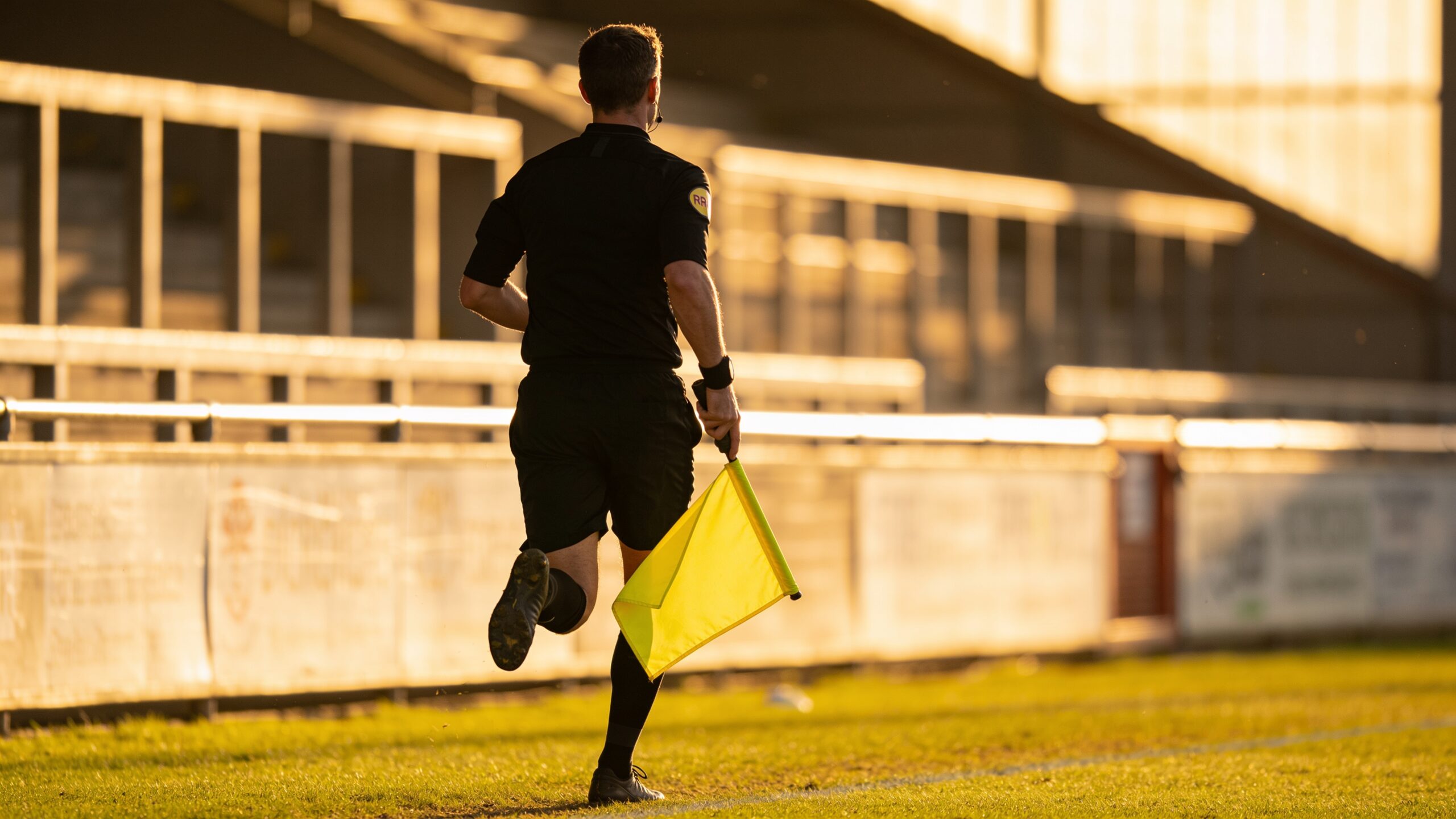
Traditionally, assistant referees on the touchline watch the line of defenders and raise a flag. Video assistant referees (VAR) now check close calls in many competitions. Manual checks used to involve drawing lines on a screen by hand and could take a long time.
Semi-automated technology
Some leagues now use semi-automated offside technology. The Premier League describes its system as using up to 30 cameras around each stadium, with several recording at 100 frames per second, about twice the rate of typical broadcast cameras. The system tracks the ball and up to 10,000 surface data points on each player, suggests the moment the ball was kicked, and draws the offside lines automatically. The League says it expects to cut the average decision time on close calls by around 30 seconds.
It is called “semi-automated” because people are still in charge. The video referee still confirms the decision, and the technology does not decide the subjective parts of the rule, such as whether a defender played the ball deliberately or whether an attacker interfered with an opponent. In those cases, the referee may review the incident on the pitch.
The “daylight” trial
You may have heard of a proposal called the “daylight” offside rule. Under it, an attacker would be onside if any part of their body that can legitimately score is level with or behind the second-last defender, and offside only if there is clear daylight between them and the defender. FIFA’s website reports that an IFAB-approved trial began in the Canadian Premier League’s 2026 season on April 4. It is a trial in one competition. It is not a permanent change to the Laws of the Game, so the rule described in this article remains the one that applies in most matches, and you should check the competition’s rules if you watch other leagues.
Quick myths, corrected
- “You can’t stand in an offside position.” You can. You are only penalised if you become involved in active play.
- “Being level is offside.” It is not. Level is onside.
- “Arms count.” They don’t, for any player.
- “You can be offside from a throw-in.” You can’t.
- “Offside depends on where you are when you receive the ball.” It depends on where you were when your teammate played it.
The short version
If you remember one sentence, make it this: an attacker is only offside if they are nearer the goal than both the ball and the second-last defender when the ball is played, and then they get involved in the play. Everything else in the rule is detail on those two ideas.