

Winter Tyres Buying Guide: What to Check Before You Buy
When the first cold mornings arrive, many drivers start asking the same questions. Do I really need winter tyres? Are all-season tyres good enough? And what should I look for so I don’t waste money? (In the US, the spelling is “tires”, but everything here applies either way.)

The honest answer starts with where you live, because the rules and the weather differ a lot from country to country. This guide explains how the rules work across Europe, the types of tyre on offer, the markings and numbers worth checking, how to buy smartly, and when to fit and swap them. It is general information, not legal or insurance advice, and it names no brands or products, since I can’t test tyres and prices change often. Always check your own country’s official rules and your vehicle’s handbook before you buy.
Do You Need Winter Tyres? It Depends on Where You Drive
Europe has no single rule
The European Consumer Centre France publishes a country-by-country overview (last updated in October 2025), and its main message is that there is no single European rule. The countries fall into roughly four groups.
- Required by dates: Some countries require winter tyres during a fixed period. Examples listed include Sweden (December 1 to March 31), Estonia, Latvia, Lithuania, Slovenia, Croatia, and Bulgaria. Denmark introduced a requirement for winter or all-season tyres with the snowflake symbol under a law from July 2025.
- Required in wintry conditions: In Germany, Austria, the Czech Republic, Finland, Luxembourg, Romania, and Slovakia, winter tyres are required when roads are icy, snowy, or slushy, rather than by a fixed date. In Germany, there is no fixed date or temperature, and the duty applies automatically when conditions such as black ice, packed snow, or slush appear.
- Required only where signs say so: In France, winter equipment is required from November 1 to March 31 in signposted areas that cover parts of 34 départements. In Italy, the obligation applies where road signs say so, normally from November 15 to April 15, with different dates in places such as the Aosta Valley.
- No requirement: Belgium, Ireland, the Netherlands, Portugal, Cyprus, Malta, and Hungary have no general winter tyre rule, although Belgium recommends them. Poland doesn’t require them either, but the Consumer Centre notes that insurers may treat not changing tyres as gross negligence.
Norway is worth a special mention. It doesn’t have a strict legal obligation, but tyres must suit the weather, and there is a minimum tread depth in winter, so winter tyres are effectively expected.
These rules change, and the pages I read could be out of date by the time you read this. Check the official government site for any country you drive in.
The United Kingdom
According to the same overview, winter tyres are not mandatory in the UK, but they are recommended when temperatures drop below 7°C. Chains and studded tyres are allowed only on snowy or icy roads.
The United States
I didn’t find a single national rule, and I haven’t verified the rules state by state. In general, winter tyre requirements, if any, come from local rules and from road conditions, so check your state’s transport department, especially if you cross mountain passes. Many safety guides also stress that the type of tyre matters as much as the law.
Insurance and fines
Rules come with penalties. In Germany, for example, fines of €60 to €120 for the driver and €75 plus a point for the owner are listed, and the official consumer pages warn that using unsuitable tyres may cause problems with your insurer after an accident. France lists a €135 fine and possible immobilization of the vehicle where winter equipment is required. Check your insurance policy wording, since this is where a wrong choice can cost the most.
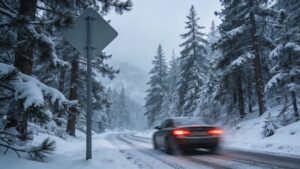
Winter, All-Season, All-Weather, and Summer: What’s the Difference?
Summer tyres
Summer tyres are built for warm weather. A US state safety sheet I read says they aren’t designed for freezing temperatures or for ice and snow. If you live somewhere with real winters, they are the type to swap out.
Winter tyres
Winter tyres use a softer rubber compound and thin cuts in the tread to grip in the cold. The same US sheet says they can stop up to 50% faster on ice and snow than other types. It also lists figures from a retailer’s test. Because the test came from a retailer, treat the exact numbers as a rough illustration, not a guarantee.
All-season tyres
All-season tyres cover a range of conditions, but the sheet says they have limited ability on ice and snow. They suit places with mild winters and rare snow, and many people choose them for convenience.
All-weather tyres
“All-weather” is a term used for tyres that carry the snowflake symbol and are meant to work year-round, including in winter. In several European countries, only tyres with this symbol count as winter tyres. That is the feature to look for, not the name on the box.
A simple way to decide
- Mild winters, rare snow or ice: Good all-season tyres, in good condition, may be enough. Check your local rules.
- Cold winters or frequent frost: Winter tyres or snowflake-marked all-weather tyres are worth considering.
- Regular snow, hills, or mountain roads: Winter tyres are the safer choice, and you may need chains too.
- Rules that require them: Follow the law first, even if the weather looks mild.
This is a rule of thumb, not a formula. Your driving, your car, and your local roads all matter.
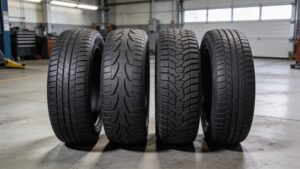
What to Look For When You Buy
The snowflake symbol
The most useful marking is the three-peak mountain snowflake symbol, often written as 3PMSF. According to the official consumer information, it is required or accepted in a growing number of countries. In France, only tyres with this symbol count as equivalent to chains where winter equipment is required. Germany, Latvia, and Sweden have also moved away from accepting the older “M+S” marking on its own.
M+S, M.S., or M&S is an older marking. It is still accepted in some countries, but no longer enough in others, so don’t rely on it alone. If you want one tyre that works across borders, look for the snowflake.
Tread depth
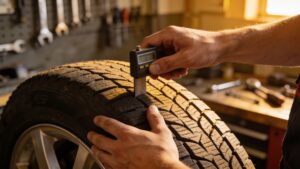
Tread is what clears water, slush, and snow from under the tyre, and legal minimums vary. The overview lists 1.6 mm in Germany, Luxembourg, and Belgium, 3 mm in several northern countries, and 4 mm in others such as Austria and Bulgaria. Germany’s official consumer page notes that the national motoring club recommends 4 mm for winter use, and Belgium recommends 4 mm too. Because the legal minimum is only a floor, it makes sense to replace tyres well before they hit it. For worn tyres, check the number for your country, not only the generic rule.
In the US, a state safety sheet suggests a quick “penny test” to check wear. I haven’t confirmed the exact depth that applies in every state, so use your state’s guidance and your tyre shop’s advice.
Size, load, and speed rating
Tyres must match your vehicle. The size, load index, and speed rating are marked on the sidewall and listed in the owner’s handbook, and in some countries the speed rating matters legally. The overview notes, for example, that Belgian rules for some M+S tyres depend on the speed index. Don’t guess. Use the numbers your vehicle’s maker lists, or ask a tyre fitter to confirm them.
Age and condition
Tyres age even when they aren’t used. A date code is stamped on the sidewall, so check it when buying, especially from a seller with older stock. I haven’t researched the exact age limits for this guide, so ask your fitter what they recommend.
Fit a full set
Several countries require winter tyres on all four wheels, and fitting only two can change how the car handles. Plan the budget for four.
Buying Smart: Cost, Timing, and Checks
Count the full cost
The tyre price isn’t the whole bill. Add fitting, balancing, valve parts, and storage for the set you aren’t using. Some people buy a second set of wheels to make seasonal swaps quicker and cheaper over time. I haven’t researched prices, so compare local quotes yourself.
Buy before the first cold snap
When the first frost arrives, fitters get busy and popular sizes can sell out. Booking early gives you more choice and shorter waits. If sales are near, such as Black Friday, apply the same checks you would to any deal: confirm the exact size and rating, compare the total price including fitting, and read the return policy first.
Use independent tests, not just claims
Motoring clubs and consumer organizations in several countries publish tyre tests. Look for recent tests from independent organizations, check that the tyre size matches yours, and treat a single test as one data point. Be careful with pages written by sellers, which may favor their own stock.
Questions to ask a fitter
- Which tyres suit my car, my roads, and my yearly mileage?
- Do they carry the snowflake symbol?
- What is the total cost, including fitting and balancing?
- What is the date code on these tyres?
- What is the return or exchange policy?
A note on getting them fitted
Have the tyres fitted by a qualified fitter, and ask for the correct pressure to be set. Tyres are a safety item, so this is a place to avoid shortcuts.

Fitting, Care, and Driving Abroad
When to switch
The UK guidance in the overview recommends winter tyres below 7°C. A US state safety sheet notes that winter tyres wear faster on warm pavement, so switch back to regular tyres in spring. A common approach is to change when temperatures settle around that level in autumn, and to change back when they rise in spring, though your local rules or conditions may differ.
Pressure and checks
Cold weather lowers tyre pressure, according to the US sheet, and underinflated tyres can wear quickly and are less safe. Don’t overinflate either. Use the pressure listed by your vehicle’s maker, found in the owner’s handbook or on the driver’s door edge, and check it regularly through winter. Check tread depth and look for damage each time you check pressure.
Storage
Keep the set you aren’t using somewhere cool, dry, and out of direct sunlight, and note which wheel position each tyre came from. Ask your fitter for storage advice, since I haven’t confirmed a specific method.
Driving abroad or hiring a car
Many winter tyre rules apply to foreign-registered vehicles too, according to the overview. If you’re driving to a country with a winter requirement, check the rules for the dates you’ll be there. If you’re hiring a car for a winter trip, ask the hire company in advance what tyres and equipment the car comes with.
Drive for the conditions
Even the best tyres don’t remove the risk. Leave extra stopping distance, brake and accelerate gently, and slow down on bridges and shaded roads where ice forms first.
A short checklist
- Check the winter tyre rules for every country or state you’ll drive in.
- Choose a tyre type that suits your climate and the law.
- Look for the snowflake symbol, not just M+S.
- Check tread depth, and replace before the legal minimum.
- Match size, load, and speed rating to your vehicle’s documents.
- Check the date code on the sidewall.
- Plan for a full set of four, plus fitting, balancing, and storage.
- Buy early, and compare total prices and return policies.
- Check pressure regularly, since cold lowers it.
- Check your insurance policy wording.
Winter tyres aren’t about buying the most expensive option. They’re about choosing the right tyre for your roads, checking a few numbers and symbols, and doing it before the first cold snap catches you out.