
Is a Robot Vacuum Worth It? The Honest Answer Nobody Else Is Giving You
Does a robot vacuum pan be worthwhile – really? This is a question that countless numbers of people are grappling with as they decide to spend anything between $150 and $1,500 on the round contraption that will supposedly vacuum the floor while they go off to do something else. Its allure is quite clear. The ambiguity is just as clear. There are people who love their robot vacuuming experience and would not consider living any other way. On the other hand, there are people who have paid $400 for one, realize it is trapped under the couch every third time it operates, and are convinced they have been utterly conned.
However, this guide does not recommend any particular model of robot vacuum cleaner. Instead, this article will provide answers to the very first question that one needs to ask: whether a robot vacuum cleaner is worth purchasing in each particular case. The true answer to this question will largely depend on the floor type in your home, the characteristics of your family, your financial abilities, and most importantly, your realistic expectations regarding the capabilities of the device.
What a Robot Vacuum Actually Does — And What It Does Not
To be able to make a choice regarding the value of investing in a robotic vacuum cleaner, you have to get an honest picture of what it will actually offer you since there’s a difference between what is advertised and what it really offers.
What Robot Vacuums Do Genuinely Well
Robot vacuum cleaners specialize in performing one particular function: cleaning the surfaces of your floors daily when there is no debris present on the surface. They perform well in daily pet hair cleaning and dusting of hard floors, and ensuring that your carpeted floors do not get dirty even though you don’t clean manually. Typically, people end up saving an hour to two hours every week due to automatic cleaning services which amount to around 50 hours annually being added to your schedule. The psychological satisfaction of maintaining clean floors through robotic assistance is often overlooked until you have owned a robot cleaner for some time.
The Limitations Most Reviews Mention Too Briefly
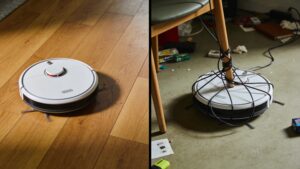
Robotic vacuum cleaners are maintenance appliances, not cleaning substitutes, and this is incredibly important information that one needs to know before buying. First of all, they cannot be used to clean stairs. Moreover, robotic vacuums have problems with thick-pile and shag carpets and rugs. In order to clean the floor efficiently, robots need an open path — wires, small objects, and children’s toys can hinder the process and prevent a robot from cleaning. Robotic vacuum cleaners are far from being an alternative to a high-quality upright or cordless cleaner when performing deep cleaning tasks.
The Floor Type Question That Determines Most of the Value
The most significant factor that will determine whether a robot vacuum is worthwhile investment is your home’s floor type. A robot vacuum is highly effective in maintaining homes that have about 70% or more hard flooring such as hardwood, tiles, laminates, or vinyl. Contemporary robots that generate over 3,000Pa of power perform very well on daily cleaning of hard floors. Robots are also relatively effective on floor types where there is a mixture of hard floors and carpets with little pile. Robotic vacuums are less effective on carpets with thick piles.
The Clutter Reality Most People Do Not Consider Before Buying
The floor needs to be sufficiently clear for the robot vacuum to be able to clean without getting stuck or frustrated. This is important for households where there are young kids, scattered objects, and many pieces of furniture. It might become necessary to assess whether it makes sense to buy one since the time saving becomes less obvious when the preparation time reaches ten minutes. The families that really benefit from the robot vacuums have relatively clear floors and an acceptable furniture layout, as well as a tendency to move cables and little objects around frequently.
Is a Robot Vacuum Worth It for Your Specific Household Type?
A robot vacuum’s worth is highly dependent on what kind of person inhabits your living space, and what their floor-cleaning problem is actually like. The following household scenarios encompass the majority of cases.
Pet Owners — The Clearest Yes in the Entire Category
In cases where pet owners face problems related to daily hair accumulation in the house on hard surfaces, it makes sense to consider purchasing a robot vacuum because this is precisely where such equipment shows its most justified price-quality ratio. Daily automatic cycles help avoid problems associated with visible fur balls which appear very fast in houses where there are dogs or cats. Only one model of the robot vacuum cleaner provides a guarantee that deals with pet mess – Roomba j9+ Combo. If this model comes into contact with a pet mess and disperses it around, iRobot replaces the unit. For houses with thick carpets and pets such as Huskies or German Shepherds, there needs to be weekly manual work with the vacuum cleaner in addition to daily robot vacuuming.
Busy Professionals and Single-Person Households
Adults who are away from their homes throughout the working day can enjoy perfectly maintained floors by just scheduling the robotic vacuum cleaner daily. Setting the robotic vacuum to operate during the day ensures that upon returning at night, the floors will already be spotlessly cleaned. This quality of life enhancer is something that every single owner of such an appliance would say was the best thing he or she ever did in terms of home purchases. It is quite simple math: If you consider your time worth more than the price of the appliance spread out through its lifetime, you buy it.
Families With Young Children
The families with children represent a much more complicated situation. Indeed, the task of keeping floors clean is especially difficult because toys and small items will be scattered around everywhere. Nevertheless, for those same families, the actual benefits of not having any crumbs, dust, and other pieces of trash accumulated all the time are especially significant since no one can clean them manually. Consequently, it makes sense to combine both solutions, and use a robot vacuum that works on an hourly basis while children go to school, provided that floors have been cleared beforehand.
Older Adults and People With Mobility Limitations
A robotic vacuum will not just be a time-saver for such people, but it will provide true value in terms of quality of life for those who struggle with vacuuming. Indeed, being able to keep the floors clean without any need to bend, lift, or push a hefty device will mean true happiness. For these cases, the best choice would be a mid-level model with good scheduling features, a docking station where the vacuum can automatically empty its dust bin, and easy-to-use application settings.
What Budget Should You Actually Spend — And What Does Each Price Point Deliver?
The robot vacuum market in 2026 spans from $100 to over $1,500 — and the differences between price points are real, specific, and worth understanding before any purchase decision.
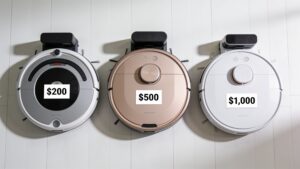
Under $250 — The Entry Point Worth Approaching With Caution
Robot vacuum cleaners below $250 offer automated cleaning functionality with rudimentary navigation features, smaller dust compartments, and lack any auto-empty functions. They function well enough in straightforward layouts and provide the essential service of automatic cleaning without having to spend more money. They have limitations indeed, such as navigating via random movements, needing regular emptying of the dust compartment, and having fewer features for avoiding obstacles, but in the case of a small flat with easy-to-clean floors and a straightforward layout, there is certainly value in purchasing an inexpensive model for the experience of seeing if it changes your approach to cleaning.
$300 to $600 — Where the Real Value Lives in 2026
The mid-range is where the robot vacuum market offers maximum value in 2026. The cost pressure on prices is quite high; products in this category were premium just twelve months ago. This price range features robots that use LiDAR technology for navigation, which means that they offer thorough cleaning by systematically visiting every room instead of bouncing around randomly. App control, programmed cleaning, zoning functionality, and even basic obstacle detection all come standard in mid-ranger vacuums. In other words, a $400 to $600 robot vacuum will be more machine than you can handle, and also exactly what you should buy.
$600 to $1,000 — Self-Emptying and Mopping Capability
The upper mid-level comes with self-emptying dock technology, which is the number one reason why such machines have earned their premium status. Self-emptying dock refers to a machine that can operate for weeks without having to be emptied, making the cleaning tool more efficient since there is no need for constant monitoring. There are also hybrid machines that come at this price level, combining automatic vacuums with mops. These kinds of mops are not used for deep floor cleaning but rather to maintain floors; therefore, they cannot be used to clean spills or deep dirt.
Over $1,000 — Premium Features With Diminishing Returns for Most Homes
In the premium class, which starts from $1,000, you receive an excellent solid-state LiDAR sensor, making your vacuum able to reach places where other vacuum cleaners cannot due to its low height, superior artificial intelligence, providing 108 different types of obstacle detection, and overall navigation. The premium class is worth its price in case you have a difficult household, such as several levels, carpets, dense furniture, and pet shedding. In case of a usual household, with clean floors, premium class will only give you better results but with additional expenses for that. In most cases, $1,300 is not more robot vacuum cleaner than $600, but less than it is needed in your house.
The Practical Questions to Answer Before You Buy
Before making any final decision, these four specific questions will tell you more accurately than any review whether a robot vacuum will actually be worth it for your specific home.
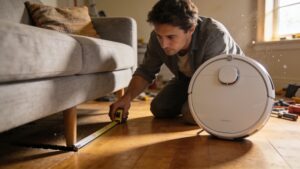
Measure the Clearance Under Your Furniture Right Now
Robot vacuum cleaners typically measure between 9cm to 10.5 cm tall. If your robot can’t crawl under your sofa, your bed, or your coffee table, it means that one of the most dusty corners in your house will be left uncleaned, thereby negating a great deal of its utility. Take measurements of all low clearances in your house before making a purchase, and ensure that these dimensions tally with the clearance of the vacuum model you are interested in buying.
Be Honest About How Often Your Floor Is Actually Clear
Just walk around your house for a moment and examine the floor in an honest light. When was the last time you saw your floor clean enough for a robot to easily move about without getting stuck or moving things? If the answer is “seldom without substantial prior preparation,” then the cleaning routine that allows for maximum robot vacuum benefits ends up being an extra step that negates any time-saving advantage. The homes that have naturally or consistently cleared floors can make far better use of robot vacuums than those who must first clear their floors.
Calculate the Real Cost Including Ongoing Maintenance
However, there are other costs involved when one decides to buy a robotic vacuum cleaner. Such include costs incurred in purchasing new brushes, filters, and dust bags in the case where the vacuum cleaner comes with a dock bag. Filters have to be changed after every two or three months while main brushes have to be replaced after six or twelve months. In the case of premium robotic vacuums, filters need changing after four or eight months depending on how often they are used. The annual cost of such replacements could range between $30-$80.
The Return Policy Question Worth Asking Before Any Purchase
With regard to how well the robot operates depending on the nature of your household, which cannot be captured in any review of the product, another purchase decision that makes sense is to buy from a merchant who provides a lengthy return period. With a return period of 30 days, you get the opportunity to see how well the robot performs by actually living with it – to find out if it is prone to getting caught underneath your particular couch, to learn how well it navigates the transition points within your floors, and whether your actual use of it will satisfy the requirements of operating a clean floor.
❓ FAQ
Q1: Is a robot vacuum a replacement for a regular vacuum cleaner?
NO – and this is the crucial expectation to be established beforehand before buying. Robotic vacuum cleaners are cleaning aids that are used on a day-to-day basis to maintain cleanliness before you conduct a deep clean. They won’t do stairs or thick pile carpets, nor will they substitute the deep cleaning capabilities of a cordless or upright vacuum cleaner. The proper perspective should be that of using robotic vacuum cleaners on a regular basis for day-to-day maintenance while the latter should be used for deep cleaning only.
Q2: How long do robot vacuums actually last?
A mid-range to high-end robot vacuum will usually last three to five years provided it is regularly maintained through regular brush, filter, and sensor cleaning. The cheaper vacuums that cost less than $200 can be expected to last for fewer years owing to their low-quality motor and componentry. The most important thing to do that can improve its life span by a large margin is cleaning and maintaining it regularly through brush roll cleaning, dust bin clearing or replacement, and cleaning of the sensors.
Q3: Are robot vacuums good for pet hair specifically?
Indeed, especially for hard floors and low pile carpet, one of the best ways to keep pet hair down is to use robot vacuums. The robot’s ability to operate automatically daily will ensure that you don’t have any visible buildup of pet hair in need of regular manual vacuuming. If your pet sheds heavily, especially on a high pile carpet, manual vacuuming once a week in addition to the daily robot vacuuming should be done. You will need an anti-tangle system if you have a pet with long hair.
Q4: What is the minimum budget for a robot vacuum that is actually worth buying?
For an efficient robot vacuum that works daily and is reliable with some basic mobile app features and programming capabilities, the cost range should be $250 – $300 in 2026. In cheaper models, below $200, there is no systematic navigation, capacity for the dust bin is small, and even quality of the build may impact its durability. With a smaller budget, you can get one for $250-$300 by Eufy and Roomba and still receive all that is essential, since other features will go unnoticed to you at this price level.
📝 Conclusion
Is the robotic vacuum cleaner worth purchasing? Yes, definitely and significantly, for those who live in households where the floors are mostly hard, there are pets in the house, or there simply is no time available to clean on a daily basis. If you have thick carpeting, a chaotic household environment on the floor, or if the expectation is that the appliance will take the place of manual vacuuming altogether, the choice is less clear cut and, most likely, negative, again unless some changes are made to accommodate its use. Once the choice is made in light of one’s household rather than in terms of the machine’s capabilities, the right answer always follows.