

A Beginner’s Daily Walking Routine You Can Actually Keep
Walking is the simplest exercise there is. You need no gym, no equipment, and no skill. Yet many people start a walking habit with big plans, such as 10,000 steps a day or an hour every morning, and drop it within two weeks. The problem is rarely motivation. The plan was simply too big for a first week.

This guide gives you a daily walking routine for beginners that starts small and builds over four weeks. You’ll see what health agencies recommend, what recent research says about step counts, and how to handle the things that usually get in the way: bad weather, short days, sore feet, and a busy schedule. Nothing here requires a fitness tracker, though a phone or a basic step counter can help.
What Walking Actually Does for Your Health
What the guidelines recommend
The U.S. Centers for Disease Control and Prevention (CDC) says adults need 150 minutes of moderate-intensity physical activity a week. That can also be 75 minutes of vigorous activity or an equivalent mix. It also recommends at least two days a week of muscle-strengthening activity. The UK’s National Health Service (NHS) uses the same 150-minute target for adults aged 19 to 64 and says a brisk 10-minute daily walk counts toward it.
Brisk walking is not a stroll. The NHS describes it as about 3 miles an hour, and gives a simple check: you can still talk, but you can’t sing the words to a song.
What the step research says
A large review published in The Lancet Public Health in 2025 pooled results from studies that measured steps with devices. It compared people who walked about 7,000 steps a day with people who walked about 2,000. The higher group had a 47% lower risk of dying from any cause, a 38% lower risk of dementia, a 28% lower risk of falls, a 22% lower risk of depressive symptoms, and a 14% lower risk of type 2 diabetes. Risk kept falling with every extra 1,000 steps, though the authors noted that for most outcomes there was no clear extra benefit beyond about 7,000 steps.
Two cautions are worth knowing. First, these are associations from observational studies. People who walk more may also differ in other ways, such as general health, income, or diet, so the study cannot prove that steps alone caused the lower risk. Second, the review’s authors listed limited data on age groups and possible hidden factors as limitations. So read these numbers as a strong hint, not a guarantee.
The most useful finding for beginners
The same research suggests the biggest gains come when a very inactive person starts moving more. You don’t need 10,000 steps to benefit. If you currently walk very little, a modest increase is where most of the benefit starts, and that is a far easier goal to keep.
Who should check with a doctor first
Walking is low-risk for most people, but talk to a doctor or other health professional before starting if you have a heart condition, chest pain, dizziness, a joint or bone problem, are pregnant, or haven’t been active for a long time and have other health concerns. Stop and seek medical help if you feel chest pain, severe shortness of breath, or faint during a walk. This article is general information, not medical advice.

Before You Start: Set Up for Success
Find your starting point
For three days, walk as you normally do and note roughly how much you walk. A phone’s built-in step counter is enough. If you don’t want to track steps at all, note the minutes instead. Your baseline matters because the goal in week one is not to hit a target. It’s to walk a little more than you do now, on purpose.
As a rough guide, about 2,000 steps is close to a mile for many adults, though this varies with height and stride length. Treat that as an estimate.
Choose shoes that don’t hurt
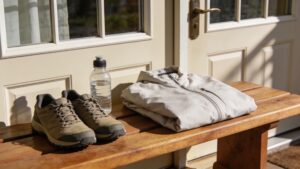
The NHS advice is simple: wear comfortable, supportive shoes that don’t cause blisters. You don’t need special walking shoes to begin. If your everyday shoes pinch, rub, or have no cushion, replace them before you increase your distance. Foot pain is one of the most common reasons beginners quit.
Pick a time and attach it to something
Habits stick when they’re tied to something you already do. Some ideas:
- Walk for ten minutes after breakfast.
- Take a short walk right after lunch.
- Walk while you take a phone call.
- Walk around the block as soon as you get home, before you sit down.
Choose one trigger and keep it the same for the first two weeks.
Pack the basics
For short walks, you need nothing. For longer ones, the NHS suggests bringing water, and in sunny weather, sun protection. In the fall and winter, add a layer you can take off and something reflective or bright if you walk near traffic at dusk.
A 4-Week Beginner Walking Plan
This plan assumes you’re healthy and starting from low activity. If walking is difficult for you, begin with whatever you can do comfortably and build from there. Slower progress is fine.
Week 1: 10 minutes a day
Walk for ten minutes at a comfortable pace, once a day, five or six days out of seven. Don’t think about speed. You should be able to chat without effort. The only goal is to show up. If you can only manage five minutes, do five.
Week 2: 15 minutes a day
Add five minutes. If you find 15 minutes in one go hard, split it into two shorter walks. Short walks count, and the NHS confirms that 10 minutes of brisk walking contributes to weekly activity targets.
Week 3: 20 minutes, with a brisk section
Walk for 20 minutes. In the middle, walk briskly for three to five minutes, using the talk test: you can speak, but you couldn’t sing. Then return to your normal pace. You are starting to build the kind of moderate-intensity activity the guidelines describe.
Week 4: 25 to 30 minutes, with two brisk sections
Aim for 25 to 30 minutes, with two brisk sections of about five minutes each. By the end of this week, you’ll be close to 150 minutes a week if you walk most days. If you don’t, that is fine. Any increase from where you started is real progress.
If you prefer to count steps
Here’s an alternative: take your baseline average and add 500 to 1,000 steps a day every week. If you walk 3,000 steps now, aim for about 3,500 to 4,000 in week one, and keep adding. A target of around 7,000 steps is a sensible goal for many adults, based on the research above, but it’s fine to stop short of it, or to go past it.
Keeping It Going: What Usually Gets in the Way
Bad weather and short days
In many places, October brings rain, wind, and earlier sunsets. A few options help. Walk at lunchtime when it’s lighter. Keep a waterproof jacket by the door. Walk laps inside a shopping center or large building. Or march in place for ten minutes during a show. On a bad day, a short indoor walk still counts.
If you walk at dusk, stay on well-lit paths, face oncoming traffic where there is no pavement, and wear something bright or reflective.
Boredom
Music, a podcast, or an audiobook can make the time pass quickly. The NHS also suggests changing your route, such as parks, canal paths, or heritage trails. Walking with another person, or joining a local walking group, makes it harder to skip.
Aches, soreness, and pain
Mild muscle tiredness in the first week or two is normal. Sharp pain, swelling, or pain that gets worse as you walk is not. If that happens, stop, rest, and speak to a health professional before continuing. If you have joint problems, the NHS notes that exercise classes in a local pool can be an easier way to stay active.
Missing a day
You will miss days. The mistake is treating one missed day as a failure and stopping altogether. A better rule is “never miss twice in a row.” Skip Tuesday, and walk on Wednesday, even for five minutes.

Making Walking Part of Your Daily Life
Small changes that add steps
You can also add steps without setting aside special time. Take the stairs when you can. Park a little farther away. Get off public transport one stop early. Walk to a colleague instead of sending a message. Take the longer route when you’re not in a hurry. These add up, and the NHS suggests building walking into your routine in exactly this way.
Track progress in a way you’ll keep up
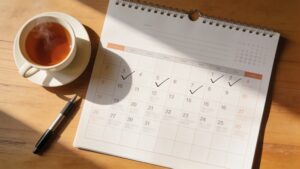
A paper calendar with a tick for each walk works well. You can also note how you feel, such as energy, mood, or sleep, because those changes are often noticeable before any number changes. Don’t judge the results by the scale. Walking supports many aspects of health, and weight is only one of them.
Add other types of movement over time
Once walking feels easy, consider adding the other part of the CDC guidelines: muscle-strengthening on at least two days a week. That could be simple bodyweight exercises such as squats and wall push-ups. You can also try walking on gentle hills, or a slightly faster pace, as your fitness grows.
A realistic way to think about it
The best walking routine is not the longest or the fastest. It’s the one you’ll still be doing in three months. Start with ten minutes tomorrow. Do it again the next day. The research suggests that even a modest increase in daily steps is worth it, and a habit you keep beats a perfect plan you drop.