
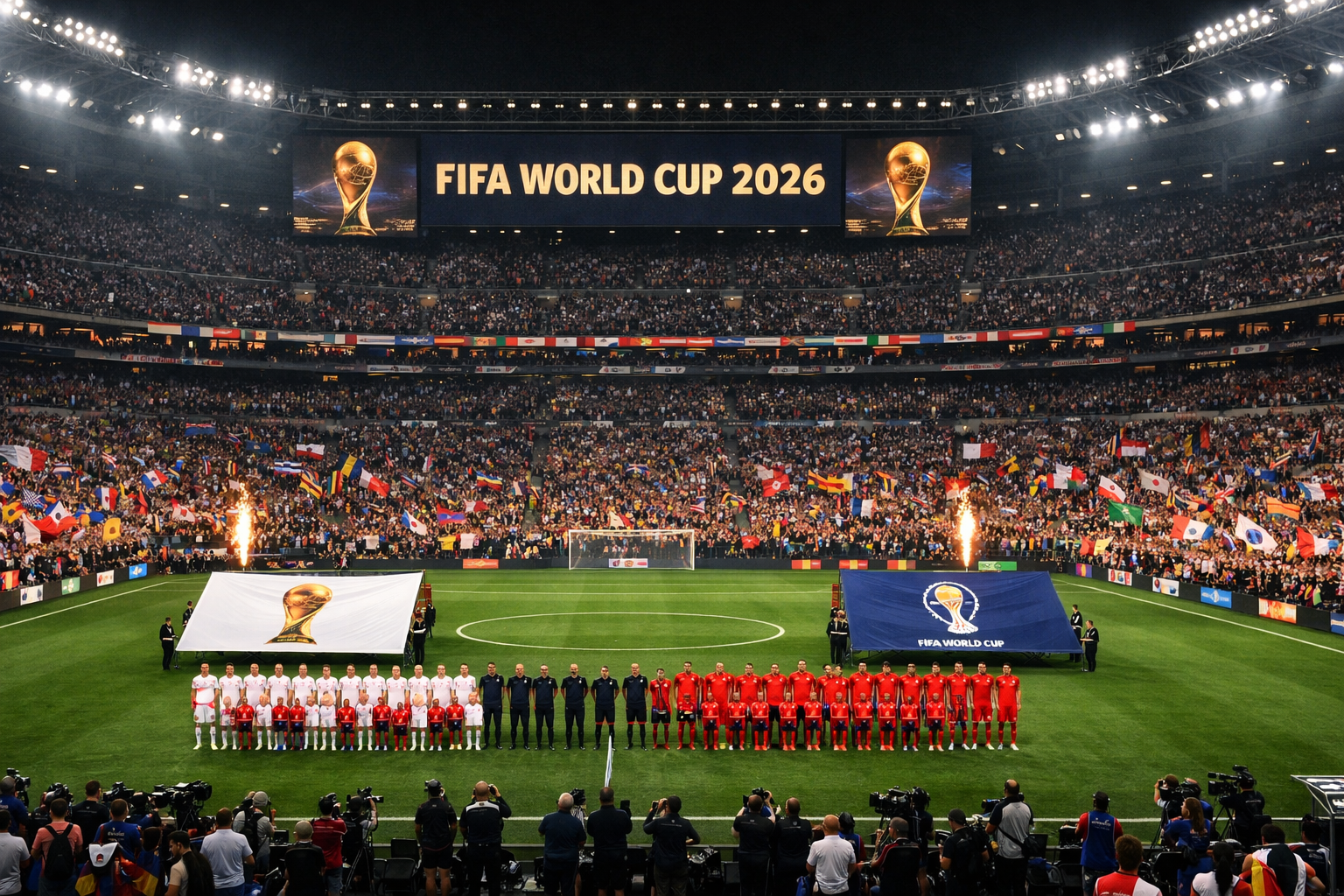
2026 World Cup Format Explained Simply
Everything there is to know about the 2026 World Cup schedule is precisely what millions of football fans around the USA, Europe, and other parts of the world have been seeking for. With valid reasons. This year’s FIFA World Cup marks one of the largest and most daring in history. Not only do we have more nations participating at once – 48 instead of regular 32 – but also a revised tournament schedule, an additional knockout stage, and almost twice as many games played – 104 instead of regular 64. If the last World Cup which caught your eye was the one held in Qatar in 2022, you might be in for some surprises.
The event will be held between June 11 and July 19, 2026, in sixteen cities belonging to three different host countries, including eleven in the US, three in Mexico, and two in Canada. It marks the first time that the World Cup will be jointly hosted by three countries, as well as the first alteration in format since the FIFA World Cup in France in 1998, where the number of participating teams was increased from twenty-four to thirty-two. It is crucial to comprehend the new format if you wish to follow the event effectively.
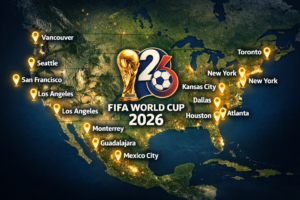
In this guide, we are going to walk through each and every step in this 2026 World Cup format process. You will have an understanding of everything that happens from the first game to the last one on July 19th at MetLife Stadium, New Jersey.
The Group Stage — 48 Teams, 12 Groups, 36 Matches
This is where everything starts, and there is a marked difference now in 2026. This phase has grown considerably in scope compared to earlier editions of the World Cup, which featured only four additional teams compared to today’s total of 48.
From 8 Groups to 12 — What Changed and Why
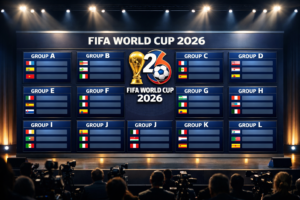
Between 1998 and 2022, each edition of the World Cup has been comprised of eight groups of four teams. In 2026, the number of such groups will increase to twelve with four teams per group (A to L). This decision by FIFA was made in March 2023, when they ruled out an initial plan for sixteen groups of three teams because of the threat to the integrity of the sport posed by the possibility of collusion between the last groups to determine who qualifies from their respective groups.
How Teams Qualify From the Group Stage
The qualification criteria in 2026 is what brings some truly fresh ideas to the table. The first and second-placed teams in each of the twelve groups qualify for the knock-out phase automatically, making up twenty-four teams altogether. Eight additional teams will be included in the Round of 32; these teams will be the eight highest-ranked third-placed teams in all twelve groups. They will be chosen based on their total number of points, goal difference, number of goals scored, fair-play rating, and FIFA world ranking. Thus, a team can still have hopes even after finishing in the third place within its group.
How Tiebreakers Work in the Group Stage
In case of a tie involving two or more sides in terms of points during the group stage round, there is a specific hierarchy of criteria used by FIFA to determine the order of finishing teams. According to the official 2026 FIFA World Cup format guide published by ESPN, these criteria are goal difference of all group games, goals scored in all group games, point gained in head-to-head matches among the involved teams, goal difference in head-to-head matches, goals scored in head-to-head matches, and the last criterion is the fair play score obtained from yellow and red cards – a yellow card is -1 point and a direct red card is -4.
Which Nations Are in the 2026 World Cup?
The draw occurred on December 5, 2025, in Washington, D.C., at the Kennedy Center. The host nations, which are the USA, Mexico, and Canada, received an automatic qualification for participation. A total of 45 positions were assigned to all other teams, each from one of the six FIFA Confederations. Europe was allocated the largest number of places, with 16 spots. There were 9 places allocated to Africa, 8 for Asia, 6 for CONCACAF, 6 for South America, and 1 for Oceania, with 2026 being its first qualification. Teams like Italy and Denmark did not qualify for the World Cup.
The Brand-New Round of 32 — The Key Change Explained
The Round of 32 is by far the most important change structurally implemented in this year’s competition. This is an entirely new round that has no precedent in the history of World Cups, and it transforms the knockout phase altogether.
What the Round of 32 Is and How It Works
The Round of 16 was always the first knockout round from the World Cup from 1998 to 2022, which included a total of 16 teams playing in eight games. In 2026, however, there will be a major change regarding the first knockout round. The Round of 32 will become the first knockout round in this World Cup, including all the 32 teams who have qualified into the knockout rounds. As noted by NBC Washington and World Soccer Talk, the Round of 32 will start on June 29 and will include a total of 16 matches. Starting from this round onward, each game will become sudden death.
From Round of 32 to the Final — The Full Knockout Path
After the end of the Round of 32, the championship adopts a pattern that all football fans are well familiar with. Sixteen winning teams enter the Round of 16, eight winners qualify for the quarter-finals, four finalists for the semi-finals, and eventually two teams meet in the finals. This makes the number of matches that one team needs to win in order to emerge victorious in 2026 increase by one game and become eight from seven as was the case before. The final match will be held on July 19 in MetLife Stadium, East Rutherford, New Jersey, with a seating capacity of more than 82,000 people and which will witness the most watched football match in history.
Why FIFA Added the Round of 32
The creation of the Round of 32 came about directly from the expansion of the number of teams playing. Because 32 teams progress past the group stage, there is now an added round to reduce the number of teams to half, ahead of starting the Round of 16. As UCFB states, the addition of another round increases the commercial and media worth of the competition, with sixteen more games added on top of the existing number of matches. Detractors say it extends the competition unnecessarily, but according to FIFA’s president, Victor Montagliani, the gap between when teams start and the finals is similar to 2014 and 2018.
How the Round of 32 Matchups Are Determined
The exact match-ups for the 32nd round stage are not pre-ordained but are contingent on the groups from which the eight third-placed team qualifiers hail. Per the format as explained by ESPN, the tournament is conducted by FIFA through use of a fixed bracket whereby the eight third-placed team qualifiers are matched based on their group combinations. The winners and the runners-up from the various groups are then seeded at opposite ends of the bracket, ensuring they cannot face one another until the final stage of the competition.
The Host Cities, Stadiums, and Key Dates
The 2026 FIFA World Cup, with its 16 cities in three nations and 104 games to arrange in 39 days, will be the most complicated sports tournament to date. Here’s everything you need to know about the venues for the matches.
The USA Venues — Eleven Cities, One Final
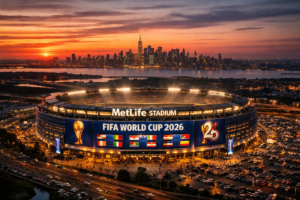
Eleven cities from the United States of America will host games in the 2026 World Cup competition: New York/New Jersey, Los Angeles, Dallas, San Francisco Bay Area, Seattle, Boston, Miami, Atlanta, Kansas City, Philadelphia, and Houston. The final match will take place at MetLife Stadium, East Rutherford, New Jersey, on July 19 at this stadium which is home to the NFL New York Giants and Jets teams, and can accommodate more than 82,000 fans. It will be the first time that the stadium hosts the final game of the World Cup, and it will be the biggest stadium to have hosted the World Cup finals.
Mexico and Canada — The Co-Host Cities
The host countries from Mexico include Mexico City, Guadalajara, and Monterrey. Mexico will face South Africa in the opening game that will be held in Mexico City on June 11. This is quite an achievement for Mexico since it has now become the first nation to host or co-host the men’s World Cup three times, considering the two other men’s World Cups in Mexico which were in 1970 and 1986 respectively. In Canada, there will be games hosted in Toronto and Vancouver. This will be the first time Canada hosts the men’s FIFA World Cup.
Key Tournament Dates Every Fan Should Know
This is how the competition schedule is arranged and confirmed by FIFA and ESPN: The groups play their matches starting June 11 through June 27. The round of 32 takes place between June 29 and July 3. The round of 16 plays its matches between July 4 and July 7. The quarterfinals will be played on July 9 and July 10. The semifinals will be conducted on July 14 and July 15. On July 18 will be the match to decide the third place, while the final match will be held on July 19 in MetLife Stadium.
How Many Matches Will There Be in Total?
There will be a total of 104 games at the 2026 World Cup. This is 63% more games compared to the number of games held at every other World Cup since 1998 until 2022. The number of games to be held per round of the competition is as follows: 48 group games in twelve groups, 16 Round of 32 games, 8 Round of 16 games, 4 Quarter Final games, 2 Semi-Final games, 1 game for the Third Place, and 1 Final match. According to UCFB’s calculations, there will be a 68% increase in the total number of games played.
What the New Format Means for Fans and Teams
In addition to the digits and parentheses, the extended format for 2026 alters the way the World Cup is followed by its devotees at home, at the tournament in North America, and by the players vying for the cup.

More Nations, More Stories, More Surprises
But it’s more than simply an increase in numbers – it will completely change the nature of the competition itself. Nine slots are set aside for Africa, eight for Asia, and one for Oceania. Countries which formerly had virtually no hope of qualifying for the FIFA World Cup level can now see a chance of doing so. According to the format assessment done by FOX Sports, a larger number of teams participating makes the possibility of the “underdog story” more likely – and many soccer fans love nothing more than an upstart nation going far unexpectedly in the world game.
Third Place in Your Group May No Longer Mean Elimination
Perhaps one of the biggest changes that will be welcomed by fans of particular sides is that which relates to qualification to the next round as the third-best team from each group. Since the 1998 World Cup, any side that ended up third in their group was sent packing early. By 2026, however, eight of the twelve teams that finish third will make it through to the Round of 32. What this means for teams is that if they lose two of their group games but still have one of the best third-placed results, then they will still advance to the knockout round.
Teams Must Now Win Eight Matches to Win the World Cup
When considering the competitiveness factor, the new format definitely adds difficulty in claiming victory. Teams who win the competition in New Jersey come September 19th, 2026 will be victorious in eight successive games without once tasting defeat. With the inclusion of the Round of 32, there is one more elimination game separating the groups from the finals. As far as powerhouse teams go, players of such nations as Brazil, France, England, and Argentina now face one additional risk of either getting an upset result or injuring a vital player.
How to Watch the 2026 World Cup in the USA and Europe
In the USA, the 2026 World Cup will be televised on FOX and FS1, while the broadcasts can also be accessed online via the FOX Sports App and Fubo TV. The Spanish broadcast is done by Telemundo and Universo. In the UK, the event will be televised on BBC and ITV, and viewers can watch all matches for free via their streaming services. The 2026 World Cup will be televised in Germany on ARD and ZDF. In France, the event will be televised on TF1 and beIN Sports. In Spain, the event will be televised on RTVE and M+.
Frequently Asked Questions About the 2026 World Cup Format (FAQ)
How many teams are in the 2026 World Cup?
There are 48 teams, compared to 32 in each tournament since 1998. They are split into 12 groups of four. It is the first expansion of the World Cup since France 1998, which was sanctioned by the FIFA Council in March 2023.
How does a team qualify from the group stage?
The first and second places from each group of twelve teams move forward by default. Additionally, the eight third places that rank highest amongst all the other third places also qualify – thereby making it thirty-two teams moving into the round of thirty-two.
Where is the 2026 World Cup Final being held?
The final will be played on 19th July 2026, at MetLife Stadium in East Rutherford, New Jersey, USA. This stadium accommodates over 82,000 fans, and will be the biggest arena to host a final match in the history of the World Cup tournaments.
How many matches does a team play to win the World Cup?
Eight victories are required for a side to claim the cup, namely three in the group stage followed by five successive wins in the knock-out phase starting from the Round of 32 up until the final match. This marks an increase of one match from all preceding World Cup tournaments.
Conclusion: The Biggest World Cup in History Starts June 11
The detailed structure of the 2026 World Cup can therefore be summed up thus; a lot of teams, a lot of matches, a new knockout stage of the competition, and a 39 day long tournament taking place in three countries and sixteen cities. This is the biggest and most daring iteration of the competition that has been held so far – and for soccer fans from America and Europe, it’s the easiest to follow too.
Regardless of whether you’re a die-hard fan of the sport or only watch it every four years, there’s no doubt about it — 2026 is going to be a year you don’t want to miss. The opening game will start in Mexico City on June 11, while the closing game will be held in New Jersey on July 19. That’s right — there will be 104 games to see!

3 thoughts on “2026 World Cup: The Biggest Format Change in 28 Years.”