
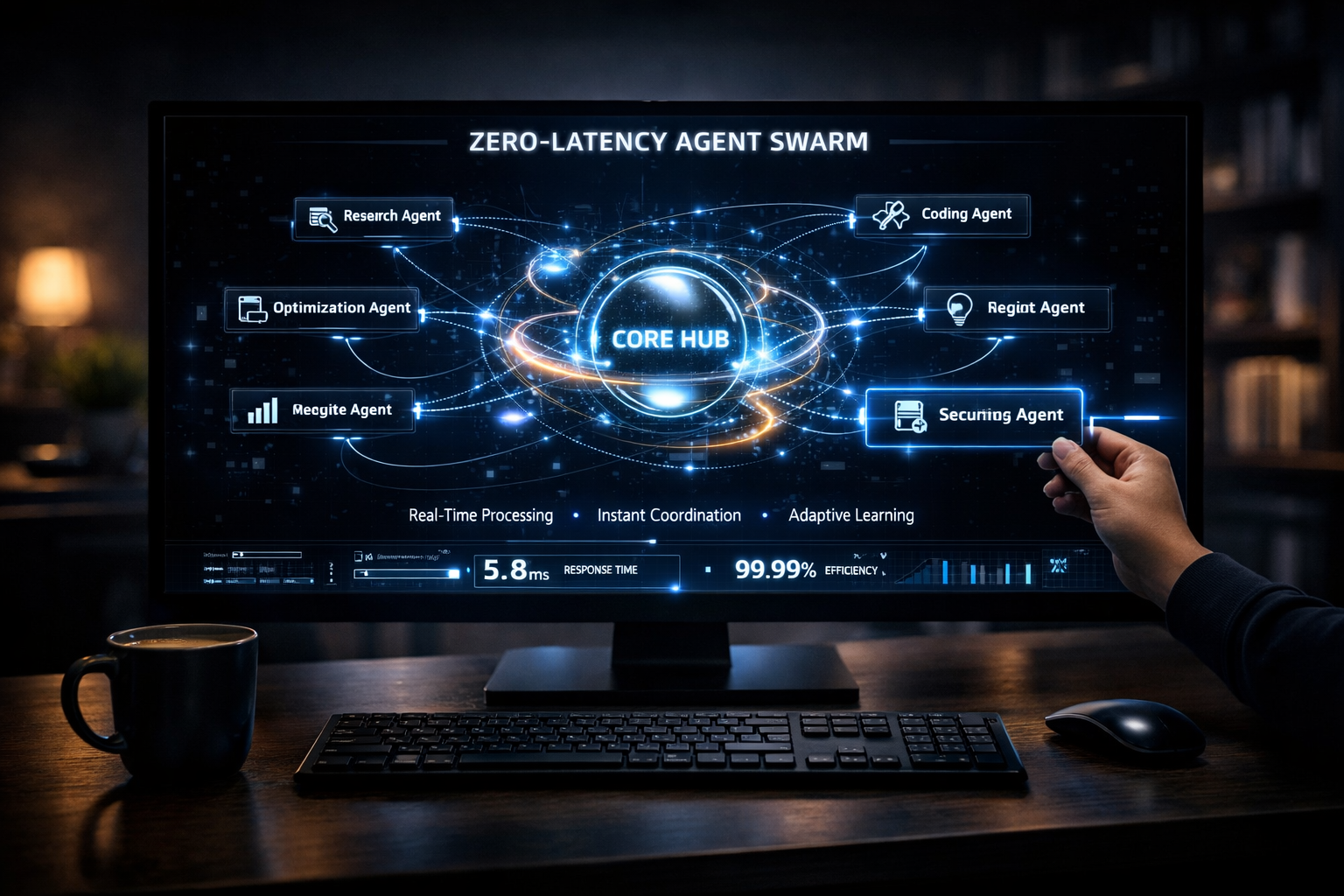
The 2026 Agency Audit: How to Orchestrate a Multi-Agent AI Workflow (Without Subscriptions)
In 2026, the digital world has finally reached its tipping point. It’s not enough anymore to “chat” with an AI; now, you need agents that can do something about it. But as far as the independent consumer or entrepreneur goes, the problem lies in making sure your agents can communicate across different platforms. For this reason, you can use the Multi-Agent AI Workflow to overcome these barriers. This framework makes use of emerging protocols like Model Context Protocol (MCP) and Agent2Agent (A2A) to achieve “Zero-Latency Interoperability.”
This is not just an advanced automation program; it marks a revolutionary paradigm in the context of digital work. Rather than the “manager” who assigns jobs to each artificial intelligence agent personally, a well-coordinated Multi-Agent AI Workflow will empower you to be the “Architect.” While you set the objective, your agents—the researcher, the drafter, and the fact-checker—work together to come up with the final product. The essay provides the roadmap to establish such an “Agency,” concentrating on privacy, efficiency, and affordability.
The Connective Tissue: 2026 Middleware and Protocols
Selecting the “language” through which the multi-agent system will communicate is the first step in creating an MAI workflow. As far as the year 2026, it is now possible to create systems that utilize smooth handovers thanks to advanced communication protocols.
The Model Context Protocol (MCP) Standard
MCP – The Model Context Protocol – has established itself as the universal interface between AI models and their inputs/output/data/other models. In creating your Multi-Agent AI Workflow, MCP becomes the universal converter. This will allow your Claude-inspired research model to directly feed its insights to a Gemini-powered creative module without losing any context or formatting in the process. If you are trying to build a “subscription-free” stack with local open-source models, you need MCP.
Implementing Agent2Agent (A2A) Interoperability
Whereas the MCP will take care of the data, the A2A protocol takes care of the “negotiation.” With the use of a sophisticated multi-agent artificial intelligence workflow, there will come a time when your agents will have to determine who among them is capable of completing a particular sub-task. The A2A protocol ensures that the “Coordinator Agent” can contact any of your specialized agents, determine their availability and “skill level,” and distribute tasks without needing any further help from you.
P2P Frameworks and Local Communication
For the ideal Multi-Agent AI Workflow, the best place to look is at P2P (Peer-to-Peer) architecture. With P2P, agents can interact through a local network instead of relying on the cloud for handling all requests. As a result, not only will you experience a lot less latency, but you will be able to use the workflow even when your internet is unreliable. In 2026, thanks to LangGraph and CrewAI frameworks, this has become possible.
Middleware Selection for the Solopreneur
The selection of proper middleware completes the connectivity picture. In a prosumer Multi-Agent AI Workflow, software options such as MintMCP and Docker’s new MCP Gateway offer an intuitive portal to handle your “Agent Fleet.” These middleware platforms serve as the centralized control panel from which you can check on the health of each agent, track the log of its dialogue, and take action if there is any “hallucination loop.”
Privacy and Regional Compliance: The GDPR-Local Audit
The European market and highly regulated markets within the United States require that any Multi-Agent AI Workflow system possess as much confidentiality as capability. By 2026, “privacy by design” will provide an edge for solopreneurs.
GDPR-Compliant Local Hosting Strategies
By 2026, the “Local-First” initiative has been embraced by the European Union. To ensure that your Multi-Agent AI Workflow is fully compliant with the GDPR laws, you have the option of deploying the “Privacy-Sensitive” agents such as Legal and Financial Agents to local hardware through applications such as Ollama and LM Studio. This guarantees that all the data remains within the confines of your premises, thus adhering to the “Data Sovereignty” clause of the European Union’s AI Act.
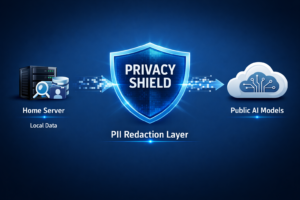
PII Shielding and Redaction Layers
When utilizing cloud-based algorithms in Multi-Agent AI Workflow design, one can still adopt the “PII Shield.” It refers to middleware technology that will automatically recognize and sanitize any Personally Identifiable Information (PII) prior to sending it out to any external API service. Afterward, once the AI gives its answer, the shield will “re-inject” the information. Such “Sanitized Orchestration” approach will enable you to employ some of the most powerful reasoning systems available today, such as GPT-5 or Gemini 2 Ultra, all without breaching any privacy regulations.
Secure “Agent Vaults” for Credential Management
The primary threat in the Multi-Agent AI Workflow is the agents’ ability to gain access to your accounts such as Gmail or Slack. In the year 2026, the technology of “Agent Vaults” will be implemented, which acts as a secure environment housing all the credentials required by the agents. Rather than having the agent knowing your password, it asks for a “temporary token” from the vault to perform an action.
The “Sovereign Agent” Identity Protocol
In 2026, the emergence of “Sovereign Identities” of AI is becoming evident. As you establish your Multi-Agent AI Workflow, you can generate a unique cryptographic ID for each individual agent. With this approach, you will be able to establish a very fine-grained audit trail, whereby each individual agent would have an entry specifying the files they accessed. The corporate clients from Berlin and London, especially those worried about “Shadow AI,” need this kind of detail.
The 2026 Agency Audit: The Compatibility Matrix
To truly win at orchestrating a Multi-Agent AI Workflow, you need to know which tools play well together. The following matrix is your “cheat sheet” for 2026 interoperability.
Orchestrating Hierarchical Workflows
Under a hierarchical workflow for Multi-Agent AI, one particular agent would be referred to as the “Manager” (a high-level reasoning model such as GPT-5), while others would be referred to as the “Workers.” In this case, the manager divides the complex prompt into different sub-tasks, allocating them accordingly. As an example, the manager could task the Research Agent to provide market trends for 2026 in Berlin and then give the Creative Agent the results to create a newsletter.
Collaborative “Swarm” Patterns
Whereas you require something more imaginative and out-of-the-box, then the “Swarm” Multi-Agent AI Workflow is better for you. In this structure, the communication among the agents happens by adopting a “Round Robin” format in which all agents work on the thoughts put forward by each one of them. This works great when it comes to making social media posts or solving problems that require imagination. A “shared memory” can be created through vector databases such as Pinecone or local Chroma.
Implementing “Human-in-the-Loop” Checkpoints
A Multi-Agent AI Workflow should never operate in a fully autonomous way—unless maybe in the future. In a business environment, “Approval Gates” must be present. For important processes such as writing an email to a client or posting something on a blog, the system takes a break and asks you for a “green light” by means of a notification sent to your phone or through Slack. You thus retain control over the “human element,” allowing you to make sure the work meets your standards.
Cross-Platform “Context Stitching”
One of the most difficult aspects when developing a Multi-Agent AI Workflow is making sure that the context remains consistent from one platform to another. For example, by 2026, we will have developed the ability to employ something called “Context Stitching,” which entails the creation of a compact context packet by a middleware layer of each agent’s output to the other. In doing so, it prevents the “telephone game” effect, whereby the last output is nothing like the prompt.
Step-by-Step Configuration: Building Your Personal OS
Now that we understand the theory, let’s look at the practical “Blueprint” for setting up your first professional-grade Multi-Agent AI Workflow.
Step 1: Defining the “Domain Skill-Set”
Before you even begin to write one line of code, you should establish what your “Jobs to be Done” are. In this case, you’ll want to design a “Staffing Plan.” You might need a “Web Search Specialist,” “Markdown Formatter,” “SEO Auditor”? By identifying your jobs accurately, you’ll know what the tiniest, cheapest model that will do that job is. An 8B model does an excellent job when it comes to Markdown formatting, whereas the “expensive” tokens of the 400B model are reserved for reasoning.
Step 2: Setting Up the “Bus” (Middleware)
After that, you have to set up your communication bus. For most prosumers, it is highly recommended that a Local MCP Gateway be set up first before diving into the creation of your Multi-Agent AI Workflow system. This application will run as an unattended process in your computer as it acts as the traffic manager. Here, you need to enter all your API keys and local models’ paths. After that, you can now register your agents by defining their identities and roles, like, “This agent has permission to read my ‘Research’ folder but not delete files.”
Step 3: Designing the “Graph” (The Logic)
The Multi-Agent AI Workflow can be likened to a flowchart. By using a software such as LangGraph or a visual orchestrator, you simply map out how your agents are connected. Here you determine what the “Triggers” are (for example, “When a new PDF file is uploaded to this directory…”) and the “Actions” (for instance, “…the document should be routed to the Research Agent to write an abstract”). Such visualization helps to identify any possible points of congestion or “Infinite Loops” that might happen.
Step 4: Stress-Testing for “Zero-Latency”
Step #8: “Latency Audit”
You need to make sure your Multi-Agent AI Workflow actually saves you time. Test your system with a specific job and measure how much time it takes to process “Time to First Token”. In case you see that handing over from one agent to another is taking too long, then maybe you need to use a P2P protocol, and also try to run more “Workers” locally. Truly optimized multi-agent workflow for 2026 should be instantaneous, with agents working quietly in the background while you think about strategy.
Frequently Asked Questions (FAQ)
What is a Multi-Agent AI Workflow?
It is an arrangement whereby various AI agents, each assigned different tasks based on its model, cooperate in order to accomplish difficult tasks. Rather than relying on a chatbot for everything, collaboration among the AI agents through protocols such as MCP leads to better automation.
Do I need to pay for 10 different subscriptions?
No. Although you may choose to go for paid models, a well-coordinated workflow of Multi-Agent AI in 2026 would be able to make use of free, open-source models, hosted locally, and “pay-as-you-go” API keys, which can be way more cost-effective than several $20/month subscriptions.
Is this only for developers?
Although at one time considered to be solely the job of coding, by 2026, there are several platforms for “Low-Code” and “No-Code” that let both professional consumers and individuals run a Multi-Agent AI Workflow without writing a single line of code.
How does this improve productivity?
The Multi-Agent AI Workflow takes care of the “Connective Tissue” in the process. The workflow transfers information, looks for mistakes, and synchronizes across applications all by itself. Now, you can spend your time working on the 5% of tasks that demand human ingenuity and discretion, whereas the rest is automated by the agents.
Is my data safe in a multi-agent system?
It depends on your setup for safety. With our Multi-Agent AI Workflow and the combination of “Local-First” and “PII Shielding,” we can ensure that all your confidential information stays on your PC and is thus more safe than any conventional cloud-based AI tool.
Final Conclusion: From “Chatting” to “Building”
Transitioning into the Multi-Agent AI Workflow model represents the end of the AI Revolution for the individual. We are no longer at the point where we can marvel at the ability to ‘talk to the computer,’ but rather have arrived at the practical application of creating a ‘digital workforce.’ For the solo entrepreneur in London, the researcher in Berlin, and the creator in Silicon Valley, this is the “Secret Sauce,” which enables one person to do what five people can do.
With your understanding of the protocols, privacy audits, and orchestration strategies described within this book, you will no longer be at the mercy of AI; rather, you will control AI. You will develop a “Personal OS” which is not only quicker, cheaper, and more private than any one-off platform but also a “Personal OS” which liberates you from mundane tasks so that you have time for the “Brilliant Glimpses.”

2 thoughts on “Orchestrating a Multi-Agent AI Workflow: The 2026 Personal OS Guide”