
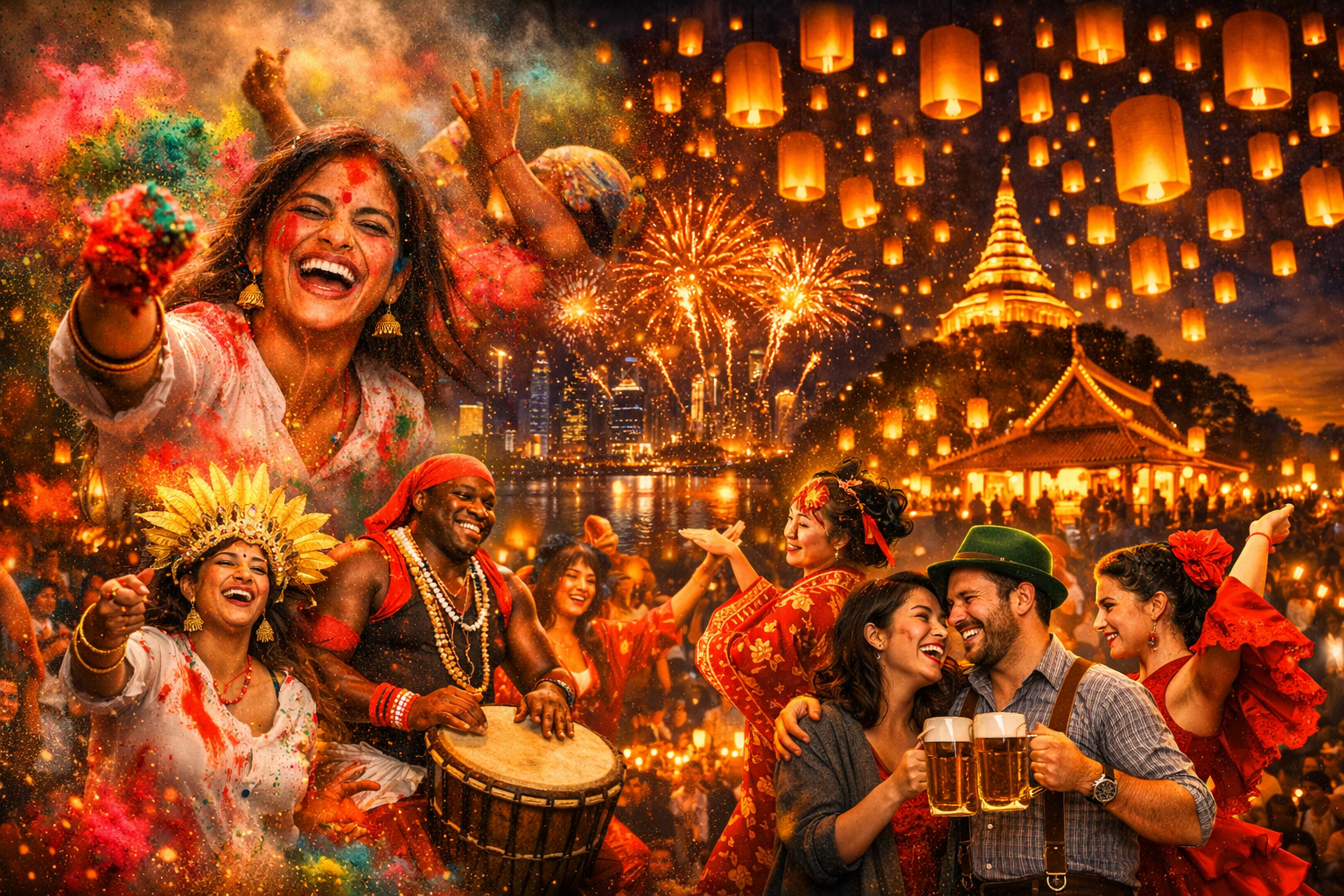
Why do people celebrate festivals differently around the world?
The variety of festival celebrations across different parts of the world will be explained through the exploration of diverse natural and cultural landscapes of Earth. These occasions are not simply public holidays but also cultural heritage and identity, as they are used as tools for preserving historical events, traditions, and values within societies for future generations. In its nature, each celebration is an answer to the unique demands of its creators.
By 2026, these traditions have undergone substantial change, as people are now able to use technology for celebrating their festivals, thus adding another dimension to this discussion. However, the fundamental reasons for organizing them, such as paying tribute to ancestors, marking seasonal changes, and thanking God for harvests, still remain identical. Through exploring the history of these distinctions, humanity can develop a better understanding of various aspects of its life.
The Role of Geography and Climate in Shaping Traditions
Agricultural Cycles and Seasons:
There is an inherent reason behind the celebration of various festivals differently by people across the globe – the climatic conditions and the landscape. Since the dawn of mankind, people have had a relationship with the earth. In agrarian societies, festivals were generally held at the onset of spring or to signify the completion of harvesting. The Mid-Autumn festival celebrated in East Asia occurs during the time of the full moon when rice is harvested, but in the Southern Hemisphere, festivals may be celebrated under completely different climatic conditions.
Availability of Resources:
The materials that form part of the celebration also depend on the physical characteristics of the area. In the hot climate of Brazil, the costumes for Carnivals are bright and airy, considering that there is plenty of sunlight in addition to the availability of bird feathers and local fabrics. On the other hand, celebrations in areas with harsh winters, like the Winter Solstice festivals in Northern Europe, revolve around fire and woolen clothes.
Geographic Isolation and Evolution:
Through many years of history, physical boundaries such as mountains and oceans have enabled separate communities to thrive independently. The ability of a culture to develop separately from others has been one of the main reasons why different societies enjoy festivals in distinct ways. For instance, if a society lives in a remote location such as the Himalayas, it continues to practice its customs without interference, resulting in more unique festivities like the Hornbill Festival in Nagaland.
Religious and Spiritual Foundations of Celebration
Commemorating Sacred Events:
The question commonly asked by many people is why people celebrate different festivals in other countries, and the answer can always be found in their beliefs. Religious festivals are created to remember miracles, births of deities, or religious triumphs. Since every religion follows a different calendar system such as the lunar calendar, the solar calendar, or the lunisolar calendar, the way they celebrate it is very different.
Symbolism and Rituals:
These rituals have significant symbolism associated with them. For instance, water is a symbol of cleansing in certain cultures, hence the creation of events such as Songkran celebrated in Thailand through splashing water at one another. Light can be the main symbol in some cultures, for example, in Hanukkah, which is depicted by the Menorah, and Yi Peng festival through the lanterns. Symbols are based on spiritual scripts and historical occurrences of different faith groups.
Moral and Social Lessons:
Apart from praying, these festivals also act as a lesson for the members of the community. It has been seen that they make use of story-telling and performances in order to instill values like bravery, compassion, and self-sacrifice in the young generation. It is evident from an analysis of “Why do People Celebrate Festivals in Diverse Ways Across Different Cultures?” that festivals act as the moral compass of the faith.
Historical Context and the Preservation of Heritage
Victories and Struggles:
The significance of history cannot be underestimated in explaining the differences in the way festivals are celebrated globally. There are many festivals which have emerged out of the struggle of a nation for its independence or the remembrance of a famous leader of that country. Examples include the Bastille Day of France, which marks an important moment in the French Revolution and the Cinco de Mayo in Mexico, which is celebrated in commemoration of a particular military victory.
Cultural Resilience:
Festivals are an act of resistance for many indigenous cultures. In today’s ever-changing world where everything seems to be globalizing, it is essential for any small group to show its presence by having a distinct festival. One such example would be the Mexican Day of the Dead, which combines Aztec rituals with later influences and celebrates both life and death in a way like no other festival in the world.
Legacy and Lineage:
These occasions can be used to connect themselves with their past. The difference in the celebration of festivals in different parts of the world may be very simple – “That is how my grandpa does it”. Such a chain of heritage ensures that even if one goes to the other side of the world, he or she will always light the same candles or make the same preparations.
Modern Trends and the Impact of Technology in 2026
The Rise of Micro-Experiences:
In 2026, the shift towards a trend is towards customizing the experience in big festivals by creating customized micro experiences for the attendees. The one-size-fits-all approach has become less popular and there is a need for something more unique. The advent of technology enables the festival-goers to customize their experience using AI apps, which recommend a particular workshop or ritual that can be followed.
Virtual and Augmented Reality:
Technology is ensuring that the celebrations become accessible. An individual in London can attend the festival in Tokyo through the use of high-definition virtual reality technology. The technology not only duplicates the real-life event but also introduces a digital layer that was not present in the first place. It will change the reasons for which individuals in different places celebrate festivals in the way that they do.
Global Discover and Social Media:
Google Discover and other platforms have made local festivals a trend worldwide. After sharing an image of a lantern festival with millions of people around the world, tourists from miles away get motivated to visit the event. The “tourist gaze” phenomenon has led to a shift in the nature of festivals, which are now becoming spectacle events, altering the ritualistic nature of such traditions to cater to a global audience.

Frequently Asked Questions (FAQ)
What is the main reason festivals vary by country?
Geography, religion, and history are some of the reasons why this happens. Geography determines the weather and natural resources, while religion is responsible for the religious perspective. History, on the other hand, gives communities their own historical happenings to celebrate.
How does climate affect festival traditions?
The weather sets the time for a festival and the mood of a festival. This is because a harvest festival needs to be conducted during autumn, and a spring festival symbolizes rejuvenation. Weather also influences the type of attire and cuisine served in festivals depending on the climate.
Are festivals becoming more similar because of globalization?
Although there is increasing commercialization of certain festivals owing to tourism, many cultures are making greater efforts to protect their distinctive customs. Globalization has, in fact, resulted in an increased interest in how people observe festivals across the world, resulting in the rise of “cultural tourism.”
Why are some festivals celebrated on different dates each year?
The dating system for many cultural celebrations often adheres to the lunar calendar, which differs from the standard Gregorian calendar. Therefore, the timing varies each year according to our contemporary calendar system. This is found in religions such as Hinduism, Islam, Chinese, and Judaism.
Final Thoughts on Global Celebrations
The investigation of different festival traditions and cultures around the globe highlights the beauty of the human soul. Festivals do not just appear when it comes to specific dates. It is a reflection of a certain cultural background, of our souls. In particular, despite being similar to all the other people in the need of celebrating some holidays, we have our own way of showing our feelings and happiness, as well as our beliefs and views on the life.
When it comes to the year of 2026 and to new technological possibilities provided by the progress, there are no obstacles to explore the diversity of holiday cultures around the globe and learn from them. Understanding the origin of the tradition leads to a deeper perception of the whole culture, which allows one to become a good traveler and even better global citizen able to perceive the world as another one perceives it.

2 thoughts on “Why Do People Celebrate Festivals Differently Around the World? (2026 Guide)”