
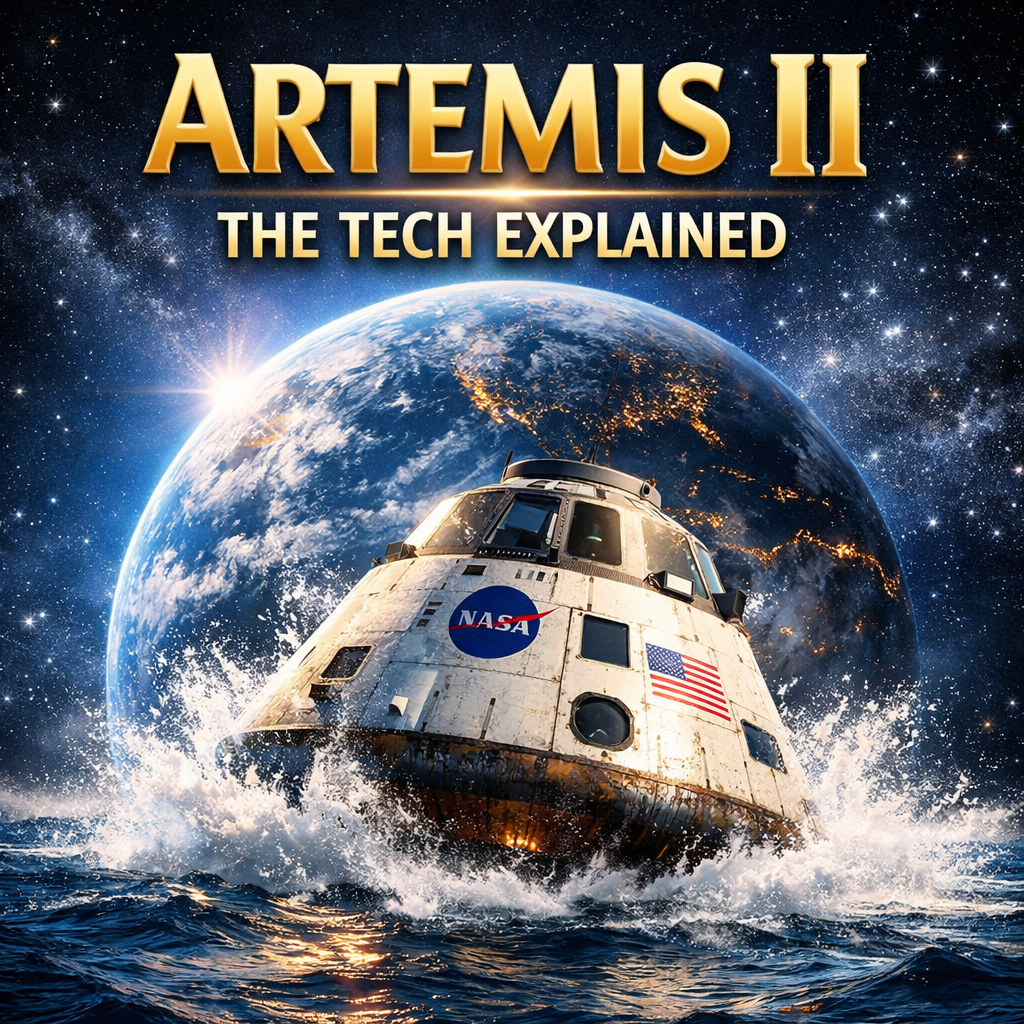
Artemis II Mission Technology: The Full Guide to Lunar Tech
The discussion about Artemis II mission technology has gained a lot of momentum after the successful landing of the Orion capsule. With our journey to the moon becoming more imminent than ever before, the intricate mechanics involved in protecting the astronauts in such an environment have become very interesting.
Unlike previous missions where astronauts simply orbited the Earth, the current mission involves a much bigger step in the evolution of technology. This mission entails a whole range of innovative technologies that can withstand the high levels of radiation and temperature variations in outer space for a prolonged period.
What is Artemis II Mission Technology?
The Core Systems:
The technology used by the Artemis II mission includes high-tech hardware and software which ensure the success of the flight to the moon and return. In contrast to earth satellites that can be helped if anything goes wrong, the system should work flawlessly for days.
The Power of the SLS:
The core of the system is the Space Launch System (SLS), which at the moment is the most powerful rocket ever created by humankind. The rocket serves the purpose of generating enough thrust for the Orion spacecraft to leave Earth’s gravitational field and fly to the Moon.
Evolution from Apollo:
Even though it is a mission similar to what was carried out back in the 1960s, it is definitely a lot more technologically advanced. The Artemis program has digital flight controls as well as composite materials that could not have been even imagined back then.
Autonomous Navigation:
Among the best features of this technology is the self-flying program installed in the spacecraft. The vehicle is capable of calculating its own path and making minor changes to its direction without being prompted to do so by the control center on Earth.
The Engineering of the Orion Heat Shield
Protecting the Crew:
Heat shield technology is possibly the most important part of the Artemis II mission. The spacecraft enters Earth’s atmosphere at a speed of 25,000 miles per hour, causing friction that raises temperatures to around 5,000 degrees Fahrenheit.
The Use of Avcoat:
The shield is constructed from a special type of substance known as Avcoat. This substance is used in a honeycomb pattern at the bottom of the spaceship. As it gets hot, the substance burns off gradually, taking the heat away from the cabin.
Thermal Protection Systems:
Apart from the basic shield, the whole exterior surface of the spacecraft is covered with thermal tiles, which are able to resist extreme temperatures of very cold shadow and scorching heat of sunlight, ensuring that the inside of the spacecraft remains at room temperature.
Testing and Validation:
Each and every inch of the heat shield is checked using laser scanning prior to launch. This is because a small crack in the shield can cause catastrophic results, which means that NASA technicians take months to ensure that the shield is totally flawless.
Advanced Communication and Data Links
The Deep Space Network:
The technology used by Artemis II utilizes an extensive worldwide system of huge radio dishes called the Deep Space Network (DSN), which enables the astronauts to establish a high-quality video link with mission control even if they are thousands of miles away from the Earth.
Testing Laser Communication:
NASA is conducting tests of laser communications systems for the very first time on this mission. Lasers can transmit data at significantly faster speeds compared to radio waves, thus enabling scientists to beam back highly detailed scientific information and even 4K videos from space.
Onboard Computing Power:
The computer systems on board Orion have higher capabilities compared to those found aboard the International Space Station. They are referred to as “radiation-hardened” because they are manufactured with additional protection against high-energy radiation that might lead to malfunctioning within their software and hardware.
Real-Time Telemetry:
The thousands of sensors distributed throughout the spaceship transmit live data back to Earth each second. In this way, it becomes possible for the engineers to keep track of every aspect, ranging from oxygen content to the strength of the spaceship’s hull.
Life Support in the Deep Space Environment
Creating a Breathable Atmosphere:
One of the most complicated technologies that have been developed for the Artemis II is the Environmental Control and Life Support System (ECLSS), which filters out carbon dioxide from the atmosphere and replaces it with fresh oxygen to create a mini-ecosystem on board the spacecraft.
Water Recovery Systems:
All water droplets, even perspiration and the condensation from breathing, are captured and re-used. This might seem quite extreme, but the filtration systems are so sophisticated that the purified water can actually be purer than the average drinking water in most large urban centers on our planet.
Waste Management Solutions:
The engineering required for constructing the bathroom in outer space is a difficult task. The Artemis spacecraft is equipped with a universal waste management system that is compact and more comfortable to use for both men and women than previous models that were used on the Space Shuttle.
Emergency Medical Kits:
The capsule has all the necessary equipment, including advanced medical equipment, because the moon is at three-day distance from the Earth. This medical equipment comprises automated diagnostic equipment and medicines for use in zero-gravity conditions in order to deal with small health problems.
The SLS Rocket: Pushing the Boundaries of Physics
Solid Rocket Boosters:
Two very large white rockets generate more than 75 percent of the total thrust, which is provided by the SLS. The rockets consume around six tons of propellant per second, making a flame column visible from hundreds of miles away during a liftoff.
The Core Stage Engines:
The large orange fuel tank contains four RS-25 engines, which were formerly employed in the Space Shuttle program. The engines have been enhanced with newer “brains,” or control systems, that enable them to operate under greater pressure and generate additional power.
Fuel Storage Challenges:
There is hundreds of thousands of gallons of liquid hydrogen and oxygen on board. Maintaining these propellants in a cryogenic state, hundreds of degrees below zero, calls for some of the best insulating material available, in order to prevent evaporation.
The Launch Abort System:
In Artemis II’s technology, the safety of astronauts is always considered paramount. In case there is any problem during the initial stages of the launching, an explosive force within a tiny rocket located atop the crew’s capsule would propel them away from the rocket.
How Lunar Tech Influences Earth’s Economy
Spinoff Innovations:
Technologies associated with Artemis II mission tend to become a part of our lives. A lot of equipment invented to facilitate space exploration becomes a part of health care, water purification, and industrial production on our planet.
Boosting the Private Sector:
NASA collaborates with many other private organizations in creating such systems. Such collaboration has helped in the formation of a “New Space” economy wherein private industries are now producing their own rockets and satellites resulting in cheaper GPS and Internet for all of us.
Advancements in AI:
The technology involved in guiding the Artemis mission is aiding engineers in enhancing the capabilities of self-driving cars and drones. The rationale behind maneuvering a spacecraft between the stars is being applied to facilitate the safe driving of automobiles around city roads.
Sustainable Power Solutions:
Solar panels and battery systems developed for Orion have caught the attention of green energy firms. This could mean future improvements in the development of household solar panels, which would generate more power than our existing ones and last longer too.
The Future: From Artemis II to Mars
The Lunar Gateway:
The final aim behind Artemis II mission technologies is preparation for a permanent facility in orbit around the Moon. This facility is known as the “Gateway” and will serve as a pit stop for astronauts venturing even further out into space towards the planet Mars.
Testing Human Endurance:
Scientists have the opportunity to learn about the effects of the deep space radiation on the human body, while being on the moon for several days. This information will be crucial when sending humans to Mars for the duration of two years.
International Cooperation:
The Artemis project includes participants from Europe, Japan, Canada, and others. This international effort guarantees that space exploration will be conducted in a cooperative manner that is beneficial to all humanity, and not just a competition among individual countries for resources.
Inspiring a New Generation:
However, the one key element of this technology would be its inspirational value. The sight of humans walking on the moon spurs many young students to take up scientific and engineering careers so that they can be innovators in the future.
Final Conclusion
Discussions about the technology needed for the Artemis II mission reveal just how far the capabilities of humans have come from their original efforts. Although the moon is far away, the technology involved in reaching it has led to innovations in communications, safety, and energy that affect everyone on Earth today.
By understanding these technologies, one can get an idea about the big picture concerning human space exploration. As technology evolves, making it possible to reach for the stars, the innovations discovered in connection with the Artemis II mission will forever be part of history.