
Thanksgiving Turkey Food Safety: A Plain Guide From Thawing to Leftovers
Somewhere around mid-afternoon on Thanksgiving, a cook stands over the oven, looks at a very large bird, and asks the question everyone dreads: is it done?
Funnily enough, the trouble with turkey usually starts days earlier, in the fridge, and it can carry on for days after the meal. So this guide follows the bird from the freezer to the leftovers. It’s built on advice from the US Department of Agriculture and on UK food agencies, and I’ve flagged the places where they disagree. Thanksgiving is on Thursday, November 26 this year, the fourth Thursday of the month, but nothing here is only for Thanksgiving. A Christmas turkey in Europe follows the same rules. This is general information, not medical advice.
One more note before we start. US advice uses pounds and Fahrenheit, so I’ve added metric figures in brackets. Those conversions are mine, so check them against your own oven and scales.
The Trouble Starts Before You Cook: Thawing
If your turkey is frozen, the thaw is the longest and easiest-to-get-wrong part of the whole job. The USDA is firm on one point: “Frozen turkeys should never be thawed on the counter or in hot water.” A food safety news report that draws on USDA advice explains why. Food sitting between 40°F and 140°F (about 4°C to 60°C) is in what it calls the “Danger Zone,” where bacteria multiply quickly.
In the fridge: slow, but the best option
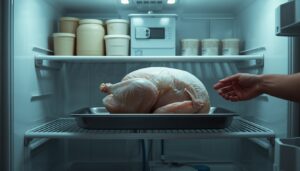
The USDA’s turkey guide gives about 24 hours for every 4 to 5 pounds (roughly 1.8 to 2.3 kg), with the bird kept in its wrapper on a tray. Its table works out like this:
- 4 to 12 pounds (about 2 to 5.5 kg): 1 to 3 days
- 12 to 16 pounds (about 5.5 to 7.5 kg): 3 to 4 days
- 16 to 20 pounds (about 7.5 to 9 kg): 4 to 5 days
- 20 to 24 pounds (about 9 to 11 kg): 5 to 6 days
Once thawed, the turkey keeps for another one to two days in the fridge, and the guide says a turkey properly thawed this way may be refrozen.
In cold water: faster, but you have to babysit it
Wrap the bird securely, submerge it in cold tap water, and change the water every 30 minutes. Allow about 30 minutes per pound (about 1 hour per kg). Cook it straight away afterwards, and don’t refreeze it.
In the microwave: only if your manual says so
Follow your microwave’s instructions for size, time and power level. Cook immediately afterwards, and again, don’t refreeze.
Working backwards from Thursday
This part is my own arithmetic, not from the sources. Count back from Thursday, November 26. For a 16 to 20 pound bird, the fridge thaw takes four to five days, so I’d put it in the fridge on Friday the 20th or Saturday the 21st. For a 12 to 16 pound bird, Sunday the 22nd is about right. Because thawed turkey keeps a day or two, starting a little early is safer than starting late.
[YOUR NOTE: one or two lines about a thaw that went wrong, or a trick that worked for you or someone in your family. A real story goes a long way here.]
Hands, Sinks and the Rule About Not Washing the Turkey
Here’s the advice that surprises people most: don’t wash the turkey.
It feels backwards. Surely rinsing a raw bird makes it cleaner? The USDA’s page says no, and it points to its own research. In that work, it says, 60 percent of kitchen sinks were contaminated after poultry was rinsed. In the UK, Food Standards Scotland puts it in blunt terms: “Never wash your turkey or any other raw poultry.” It says cooking kills the bacteria, and rinsing can spread germs such as campylobacter around the kitchen. A joint release from a UK council and the Food Standards Agency says the same.
If you do rinse it anyway, the USDA says to clean and sanitise the sink and everything around it afterwards.
Hands matter more than people think
The same USDA page says that in the research it cites, participants “did not wash their hands sufficiently about 95 percent of the time.” That figure comes from a 2020 page, and I don’t know how big the study was, so treat it as a reminder and not an exact measure. The food safety news report recommends washing with soap and water for at least 20 seconds, and sanitising any surface that touched raw turkey.
Keep raw and ready-to-eat apart
Use separate cutting boards and utensils for raw meat and for food that won’t be cooked again, such as salad or bread. UK guidance says the same. After they’ve touched raw poultry, clean boards, dishes and utensils with warm soapy water.
The giblets
The USDA says to take the giblets out after thawing and cook them separately.

Is It Done? The Thermometer Answer
You can’t tell by looking. That’s the plain truth, and it’s why every source says to use a food thermometer.
The number to hit
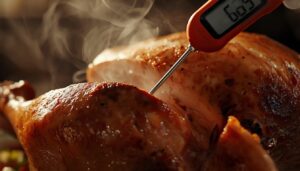
The USDA’s turkey guide says a whole turkey is safe “when cooked to a minimum internal temperature of 165 °F” (about 74°C). Check three places: the thickest part of the breast, the innermost part of the wing, and the innermost part of the thigh. The guide suggests putting an oven-proof thermometer in the inner thigh at the start, and checking the wing and breast once the thigh reaches 165°F.
The pop-up button is not a thermometer
Both USDA pages are clear that a pop-up timer is no substitute. Even if your bird has one, check all three spots.
Oven temperature
Set the oven no lower than 325°F (about 163°C). The USDA says slow-cooking below that is unsafe. If you’re cooking from frozen, the guide says it takes at least 50 percent longer than a thawed bird. Then let the turkey stand for 20 minutes before you carve it.
What the UK says
Food Standards Scotland says to check the thickest part and reach at least 75°C, with no pink meat and clear juices. That’s within a degree of the US figure, so the two are saying essentially the same thing. If you want one number for both systems, I’d aim just above them, around 75°C or 167°F. That is my own suggestion. One UK page I read didn’t give a temperature at all, only “no pink meat” and clear juices, which I wouldn’t rely on by itself.
Stuffing
The USDA doesn’t recommend stuffing the bird. Cooking the stuffing separately lowers the risk of cross-contamination. If you stuff it anyway, the guide says to keep wet and dry ingredients apart, mix just before filling, fill loosely, cook immediately, and make sure the stuffing reaches 165°F at the centre. Remove all of it from the bird after cooking.
Leftovers: Where US and UK Advice Don’t Match
Dinner’s done, everyone’s full, and the turkey sits on the table while people chat. This is where the next risk begins.
The two-hour rule
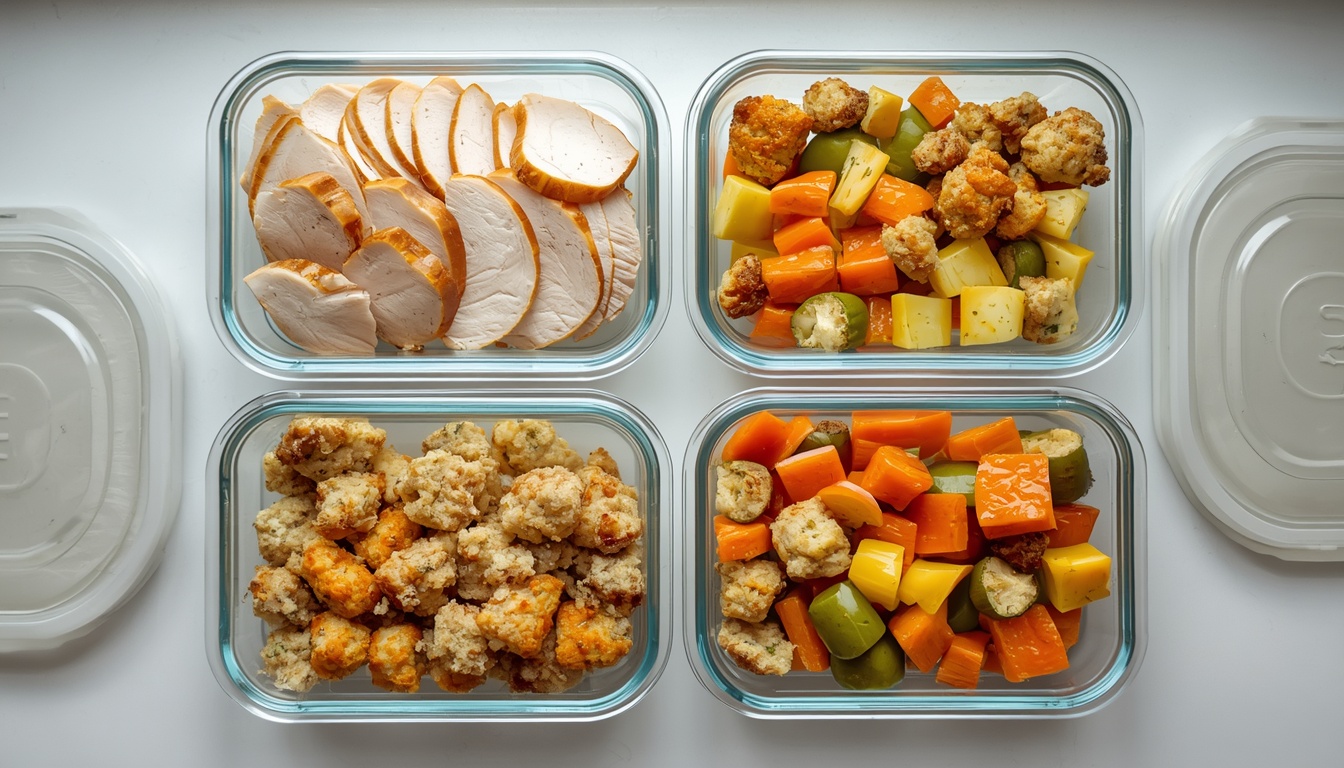
The USDA guide says to discard turkey, stuffing and gravy that has been left out at room temperature for more than two hours, or more than one hour if it’s hotter than 90°F (about 32°C). Divide leftovers into small, shallow, covered containers so they cool quickly.
How long they last: the sources disagree
- USDA’s turkey guide: refrigerated leftovers within 3 to 4 days. A news report on USDA advice from November 2025 says 4 days.
- Food Standards Scotland: eat cooked turkey within 48 hours, or freeze it.
- A UK council release with the Food Standards Agency: two days in the fridge, or freeze within one to two hours of cooking.
So it’s four days on one side of the Atlantic and two on the other. I can’t tell you why they differ, and none of the pages I read explain it. If you’re unsure, I’d choose the shorter time. That’s my own suggestion.
Freezing and reheating
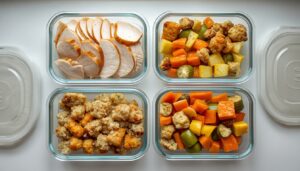
The USDA says frozen leftovers keep their best quality for two to six months. Reheat to 165°F, and check several spots with a thermometer. In the oven, cover the turkey and add a little broth or water to keep it moist. Food Standards Scotland adds that you should reheat leftovers only once. The USDA also says cold turkey is safe to eat, so a sandwich straight from the fridge is fine.
A Simple Plan for the Week
These steps are my own suggestions, built from the sources:
- Early in the week: work out the thaw date. Put the bird in the fridge on a tray, in its wrapper.
- The day before: make sure you have a food thermometer, a clear fridge shelf for leftovers, and plenty of small containers.
- On the day: wash hands often, keep raw turkey away from everything else, and don’t wash the bird.
- To check it’s done: thigh, wing, breast. All three at 165°F (74°C), then let it stand for 20 minutes.
- After the meal: put leftovers in the fridge within two hours, in shallow containers.
- In the days after: choose your timeline and stick to it. Four days if you follow the US guide, two if you follow the UK one.
[YOUR NOTE: one line about your own Thanksgiving, or whichever meal this fits: who you cook for, or what the family argues about.]
If you have questions on the day
The USDA runs a Meat and Poultry Hotline, 1-888-674-6854, and one of the pages says it’s staffed weekdays from 10 a.m. to 6 p.m. Eastern. A November 2025 report says it also opened on Thanksgiving Day, from 8 a.m. to 2 p.m. Eastern. Hours change, so check before you rely on them. If you’re outside the US, your national food agency will have its own helpline or website.
What I haven’t covered
I haven’t covered who is most at risk from food poisoning, such as pregnant women, older adults, young children or people with weakened immune systems. If that’s your household, ask a doctor or your national food agency for advice that fits. I also haven’t covered other ways to cook a turkey, such as frying, grilling or smoking, because the pages I read were about roasting.
Good turkey doesn’t need to be complicated. Start the thaw early, don’t wash the bird, trust a thermometer more than your eyes, and get the leftovers cold quickly. Do those four things and the afternoon question gets a lot easier.